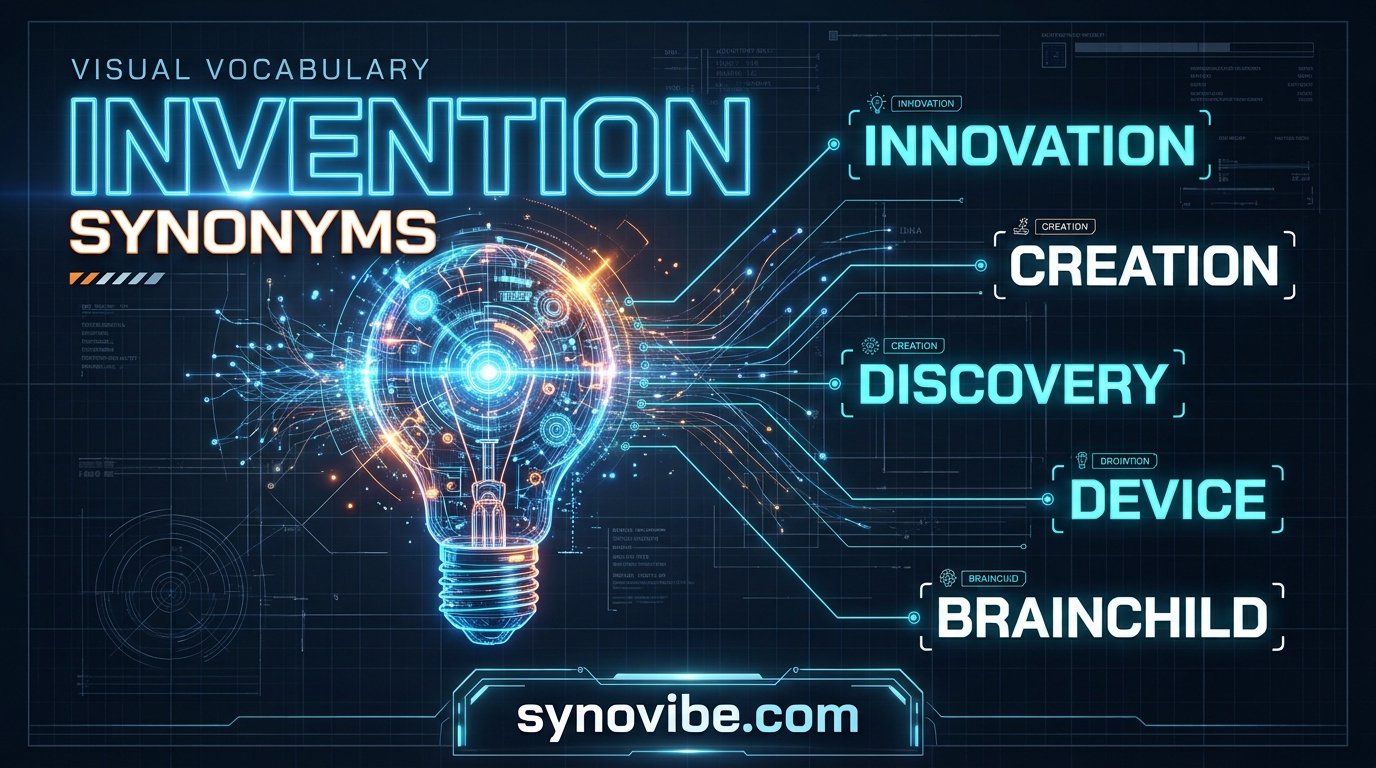
What is another word for invention? Common invention synonyms include creation, innovation, discovery, contrivance, device, breakthrough, and development. The best alternative depends on what you want to describe, whether it is a new machine, an original idea, a useful process, or something created through imagination.
Understanding different words for invention helps you communicate more clearly in academic writing, professional communication, everyday conversations, and creative projects. Although many related words describe something new, they do not all have the same meaning. For example, an invention is something created through ingenuity, while a discovery involves finding something that already exists.
In this guide, you will learn 30 invention synonyms, their simple meanings, practical example sentences, and the situations in which each word works best.
Quick Answer: What Is a Synonym for Invention?
The most common synonyms for invention are:
- Creation: Something brought into existence.
- Innovation: A new idea, method, or improvement.
- Contrivance: Something cleverly designed or arranged.
- Device: A tool or piece of equipment designed for a purpose.
- Brainchild: An idea or project created by someone’s imagination.
- Breakthrough: An important advance or achievement.
- Development: The process or result of creating or improving something.
- Conception: An idea formed in the mind.
- Design: A plan or arrangement for making something.
- Ingenuity: The ability to develop clever ideas or solutions.
Best overall synonym: Creation is a broad alternative when invention refers to something made or brought into existence. Use innovation when emphasizing novelty or improvement, and device when referring to a physical object.
Meaning and Usage of Invention
What Does Invention Mean?
An invention is something new that a person creates through imagination, experimentation, knowledge, or practical problem-solving. It can be a physical object, a technical process, a method, or a fictional idea.
For example:
- The engineer’s invention made farming more efficient.
- Her latest invention helps people save electricity.
- The writer’s invention of an imaginary world made the novel exciting.
The word invention is commonly used as a noun. It can describe both the result of inventing something and, in some contexts, an invented idea or story.
Different Types of Invention
The appropriate synonym depends on the type of invention you are discussing.
1. A physical invention
A physical invention is an object, machine, tool, or piece of equipment designed to perform a task.
Example: The scientist developed a new device for measuring air quality.
Useful alternatives include device, contrivance, and apparatus.
2. An original idea
An invention can be an idea created through imagination or intellectual effort.
Example: Her invention of a new storytelling technique attracted attention.
Useful alternatives include creation, conception, and brainchild.
3. A technological advancement
Some inventions introduce new technology or significantly improve existing products and processes.
Example: The invention of a more efficient battery helped improve energy storage.
Useful alternatives include innovation, breakthrough, and technological advance.
4. A fictional or imaginary creation
Invention can also refer to something imagined rather than physically created.
Example: The detective discovered that the entire story was an invention.
Useful alternatives include fabrication, fiction, and make-believe, depending on the intended meaning.
Invention vs. Discovery
Although invention and discovery are sometimes used in similar contexts, they describe different things.
An invention involves creating something that did not previously exist in that particular form. A discovery involves finding or recognizing something that already exists but was previously unknown or unnoticed.
For example:
- Invention: A designer creates a new type of water filter.
- Discovery: A researcher identifies a previously unknown mineral.
This distinction is important in scientific, historical, and academic writing.
30 Synonyms for Invention With Meanings and Examples
The following words offer useful alternatives to invention. Some are direct substitutes in particular contexts, while others are closely related terms with distinct meanings.
1. Creation
Simple meaning: Something brought into existence through effort, imagination, or skill.
Example sentence: The artist’s latest creation combines traditional techniques with modern materials.
Best usage/context: Use creation when emphasizing the result of making something new. It works well for objects, artwork, ideas, and imaginative projects.
2. Innovation
Simple meaning: A new idea, method, product, or improvement.
Example sentence: The company’s latest innovation reduces the amount of water needed for manufacturing.
Best usage/context: Use innovation in business, technology, education, and scientific discussions. It is especially appropriate when an invention introduces a useful improvement or a new approach.
Important distinction: An innovation may improve an existing invention rather than create something entirely new.
3. Discovery
Simple meaning: The act of finding or recognizing something previously unknown.
Example sentence: The discovery of the new mineral changed the researchers’ understanding of the region.
Best usage/context: Use discovery when something is found, identified, or understood for the first time.
Important distinction: Discovery is related to invention but is not usually a direct synonym because it involves finding something rather than creating it.
4. Contrivance
Simple meaning: A cleverly designed object, arrangement, or mechanism.
Example sentence: The inventor built a simple contrivance that opened the window automatically.
Best usage/context: Use contrivance when describing a device or arrangement that shows clever design. The word can sometimes suggest that something is artificial or unnecessarily complicated.
5. Device
Simple meaning: A tool or piece of equipment designed for a particular purpose.
Example sentence: The engineer invented a device that detects leaks in underground pipes.
Best usage/context: Use device when the invention is a physical object, particularly a machine, electronic tool, or practical instrument.
6. Breakthrough
Simple meaning: An important advance that overcomes a problem or creates a new opportunity.
Example sentence: The new battery design represents a breakthrough in energy storage.
Best usage/context: Use breakthrough when an invention produces a significant advance in science, medicine, technology, or another field.
Important distinction: Not every invention is a breakthrough. The word implies considerable importance or progress.
7. Development
Simple meaning: The process or result of creating, improving, or advancing something.
Example sentence: The development of a low-cost irrigation system helped local farmers.
Best usage/context: Use development when discussing the creation or improvement of a product, technology, process, or system.
Important distinction: Development often emphasizes the process of improvement rather than the original act of invention.
8. Conception
Simple meaning: An idea or plan formed in the mind.
Example sentence: The original conception for the machine came from a problem the engineer faced at work.
Best usage/context: Use conception when discussing the formation of an idea before it becomes a finished invention.
9. Design
Simple meaning: A plan or arrangement that explains how something will be made or work.
Example sentence: The designer created a new design for a lightweight wheelchair.
Best usage/context: Use design when emphasizing the structure, appearance, or planned operation of an invention.
Important distinction: A design is not always an invention. It may describe an existing product or a proposed improvement.
10. Brainchild
Simple meaning: An idea, project, or creation that originates from someone’s mind.
Example sentence: The community garden was her brainchild, developed after months of planning.
Best usage/context: Use brainchild when highlighting the person responsible for an original idea or project.
11. Ingenuity
Simple meaning: The ability to solve problems through clever and original thinking.
Example sentence: The engineer used remarkable ingenuity to build a machine from inexpensive materials.
Best usage/context: Use ingenuity when emphasizing the creativity or problem-solving ability behind an invention.
Important distinction: Ingenuity describes a quality or ability, not the invented object itself.
12. Fabrication
Simple meaning: The process of making something, often by assembling or shaping materials; it can also mean an invented falsehood.
Example sentence: The fabrication of the experimental device took several weeks.
Best usage/context: Use fabrication in manufacturing, engineering, and construction when discussing the production of an object.
Important distinction: In everyday communication, fabrication can also mean a lie or false story. Consider the context carefully.
13. Formulation
Simple meaning: The creation or development of a plan, method, theory, or mixture.
Example sentence: The formulation of the new cleaning solution required several experiments.
Best usage/context: Use formulation when an invention involves developing a chemical mixture, strategy, theory, or systematic method.
14. Apparatus
Simple meaning: A set of equipment or a device designed for a particular task.
Example sentence: The laboratory built a specialized apparatus to test the new material.
Best usage/context: Use apparatus in scientific, technical, and industrial contexts, especially when referring to equipment with a specific function.
15. Gadget
Simple meaning: A small tool or device designed to make a task easier.
Example sentence: She invented a handy gadget that keeps charging cables organized.
Best usage/context: Use gadget for small, practical, and often interesting devices, particularly consumer products and everyday tools.
16. Mechanism
Simple meaning: A system of parts that work together to perform a function.
Example sentence: The inventor designed a new mechanism for locking the storage compartment.
Best usage/context: Use mechanism when the important feature of an invention is how its parts work together.
17. Tool
Simple meaning: An object or instrument used to perform a task.
Example sentence: The carpenter created a specialized tool for cutting narrow grooves.
Best usage/context: Use tool when the invention helps someone complete a practical activity.
18. Method
Simple meaning: A particular way of doing something.
Example sentence: The researcher introduced a new method for testing water quality.
Best usage/context: Use method when an invention is a process or approach rather than a physical object.
Important distinction: A method may be newly developed without being a technological invention.
19. Technique
Simple meaning: A particular skill or way of carrying out an activity.
Example sentence: The photographer developed a new technique for capturing images in low light.
Best usage/context: Use technique when discussing a new practical or creative way of performing a task.
20. Procedure
Simple meaning: A series of steps followed to complete a task.
Example sentence: The laboratory introduced a new procedure for safely handling the material.
Best usage/context: Use procedure when the invention involves a structured sequence of actions or an improved operating process.
21. Innovation in Design
Simple meaning: A new or improved approach to planning how a product looks or works.
Example sentence: The chair’s adjustable frame is an innovation in design.
Best usage/context: Use this phrase when emphasizing an original design feature or a significant improvement in a product’s form or function.
Important distinction: This is a descriptive phrase rather than a single-word synonym for invention.
22. Breakthrough Invention
Simple meaning: An invention that introduces a particularly important advance.
Example sentence: The breakthrough invention made it possible to purify water more efficiently.
Best usage/context: Use this phrase when an invention has exceptional practical or technological importance.
Important distinction: It is a more specific expression than invention, not a general replacement for every use of the word.
23. Brainstorm
Simple meaning: To generate ideas, often by thinking creatively with others.
Example sentence: The students brainstormed ideas for a device that could reduce household waste.
Best usage/context: Use brainstorm when discussing the process of generating possible inventions.
Important distinction: Brainstorming is an activity, not an invention itself.
24. Ideation
Simple meaning: The process of generating and developing ideas.
Example sentence: The design team spent the morning on ideation before choosing a concept for its new product.
Best usage/context: Use ideation in product design, business planning, research, and creative problem-solving.
Important distinction: Ideation describes the formation of ideas, not necessarily the finished invention.
25. Prototype
Simple meaning: An early model of a product used for testing and improvement.
Example sentence: The engineering team tested its prototype before manufacturing the final device.
Best usage/context: Use prototype when referring to an early version of an invention.
Important distinction: A prototype is a stage in the development of an invention, not a synonym for the complete invention in every context.
26. Modification
Simple meaning: A change made to improve or alter something.
Example sentence: A small modification to the machine increased its efficiency.
Best usage/context: Use modification when an invention involves changing an existing object, design, or process.
Important distinction: A modification may be minor and does not necessarily qualify as a new invention.
27. Adaptation
Simple meaning: A change that makes something suitable for a different purpose or situation.
Example sentence: The adaptation of the original pump allowed it to operate in colder conditions.
Best usage/context: Use adaptation when an existing invention is adjusted for a new environment, user, or application.
28. Fabrication of an Idea
Simple meaning: The creation of an idea or account, sometimes with the implication that it is false.
Example sentence: The supposed historical invention turned out to be a fabrication rather than a genuine event.
Best usage/context: Use this phrase when discussing an invented story, false claim, or deliberately constructed account.
Important distinction: This expression usually has a negative meaning and should not replace invention when discussing a genuine technological achievement.
29. Fiction
Simple meaning: Something imagined rather than presented as factual.
Example sentence: The author explained that the remarkable machine in her novel was entirely fictional.
Best usage/context: Use fiction when an invention exists only in an imaginary story or when invention means something made up.
Important distinction: Fiction can describe an invented story, but it is not a synonym for a real machine or technological achievement.
30. Ingenuity-Driven Creation
Simple meaning: Something created through clever thinking and problem-solving.
Example sentence: The low-cost water filter was an ingenuity-driven creation designed for rural communities.
Best usage/context: Use this descriptive phrase when you want to emphasize the creativity and practical intelligence behind a new product or solution.
Important distinction: This is a descriptive expression, not a standard single-word synonym. In most ordinary sentences, creation or innovation will sound more natural.
Comparison Table: Which Invention Synonym Should You Use?
The following table compares common alternatives according to their meanings and best uses.
| Synonym | Main meaning | Best context | Example |
| Creation | Something brought into existence | Art, ideas, products | The creation solved a common problem. |
| Innovation | A new idea or improvement | Business and technology | The innovation reduced energy use. |
| Discovery | Finding something previously unknown | Science and research | The discovery revealed a new mineral. |
| Contrivance | A cleverly arranged device | Mechanical objects | The contrivance opened the gate. |
| Device | An object designed for a purpose | Tools and technology | The device measured temperature. |
| Breakthrough | A significant advance | Research and technology | The breakthrough improved treatment. |
| Development | Creation or improvement over time | Products and processes | The development improved efficiency. |
| Conception | An idea formed in the mind | Planning and creativity | The conception inspired the project. |
| Design | A plan for how something works or looks | Engineering and product development | The design improved safety. |
| Brainchild | Someone’s original idea or project | Personal achievements | The app was her brainchild. |
| Ingenuity | Cleverness in solving problems | Creative problem-solving | Ingenuity made the solution possible. |
| Fabrication | Making something or inventing a falsehood | Manufacturing or deception | The fabrication took two days. |
| Formulation | Developing a plan, mixture, or theory | Chemistry and planning | The formulation improved stability. |
| Apparatus | Equipment for a specific task | Laboratories and industry | The apparatus measured pressure. |
| Gadget | A small, useful device | Everyday technology | The gadget organized the cables. |
| Mechanism | Parts working together | Engineering | The mechanism controlled movement. |
| Tool | An instrument for a task | Practical applications | The tool simplified repairs. |
| Method | A way of doing something | Processes and research | The method saved time. |
| Technique | A particular way to perform a task | Art, science, and skills | The technique improved accuracy. |
| Procedure | A sequence of steps | Operations and laboratory work | The procedure reduced errors. |
| Innovation in design | A new or improved design approach | Product design | The innovation improved comfort. |
| Breakthrough invention | An invention with major significance | Scientific advances | The breakthrough invention improved storage. |
| Brainstorm | Generating ideas | Creative planning | They brainstormed possible solutions. |
| Ideation | Developing ideas | Design and business | Ideation shaped the final concept. |
| Prototype | An early model | Product testing | The prototype passed the test. |
| Modification | A change to something existing | Product improvement | The modification increased durability. |
| Adaptation | Adjusting something for a new purpose | Reuse and customization | The adaptation improved performance. |
| Fabrication of an idea | Constructing a claim or false account | Fiction or deception | The claim was a fabrication. |
| Fiction | An imagined story or concept | Literature and storytelling | The machine existed only in fiction. |
| Ingenuity-driven creation | A creation based on clever problem-solving | Descriptive or promotional writing | The creation addressed a practical need. |
Quick tip: For most general writing, start with creation or innovation. Choose a more specific word when you want to highlight the invention’s physical form, creative origin, technical importance, or development process.
How to Choose the Right Synonym for Invention
The best synonym depends on your intended meaning, the tone of your writing, and the information you want to emphasize.
1. Choose According to Tone
Different synonyms create different impressions.
For everyday English
Use creation, device, tool, or gadget.
Example: He designed a useful gadget for organizing kitchen utensils.
These words are easy to understand and suitable for everyday conversations.
For academic or professional writing
Use innovation, development, formulation, or technological advance.
Example: The innovation improved the reliability of the water purification system.
These terms work well in reports, research discussions, and professional documents.
For formal or technical writing
Use apparatus, mechanism, procedure, or conception, depending on the context.
Example: The apparatus was developed to measure changes in air pressure.
These terms are useful when precision matters more than conversational simplicity.
For creative writing
Use brainchild, creation, contrivance, or fiction when the intended meaning supports them.
Example: The mysterious contrivance appeared to have been built centuries earlier.
These words can give a description more personality or atmosphere.
2. Choose According to Meaning
Ask yourself what aspect of the invention you want to describe.
- Something newly created: Choose creation.
- A new or improved solution: Choose innovation.
- A physical object: Choose device, tool, or gadget.
- A significant technological advance: Choose breakthrough.
- The original idea: Choose conception or brainchild.
- The ability behind a clever solution: Choose ingenuity.
- An early model: Choose prototype.
- An improved version of an existing product: Choose modification or adaptation.
- A way of performing a task: Choose method or technique.
- Something imaginary or untrue: Choose fiction or, when appropriate, fabrication.
Selecting a word based on meaning helps you avoid inaccurate substitutions.
3. Choose According to Intent
Your purpose also affects which synonym sounds most natural.
When describing an achievement
Use innovation or breakthrough.
Example: The breakthrough transformed the way the factory stored energy.
When explaining how something was made
Use creation, development, or fabrication.
Example: The development of the new machine required careful testing.
When highlighting the inventor
Use brainchild.
Example: The educational app was the scientist’s brainchild.
When discussing the planning stage
Use conception or ideation.
Example: The conception of the new product began with a simple question.
When discussing how something works
Use mechanism or apparatus.
Example: The mechanism allows the machine to adjust its speed automatically.
When describing an imagined object
Use fiction or contrivance, depending on whether you mean an imaginary concept or a cleverly constructed device.
Example: The extraordinary machine was a fictional invention in the novel.
4. Consider the Sentence Structure
Not every synonym fits grammatically into every sentence.
For example:
- Original: The invention changed the industry.
- Natural alternative: The innovation changed the industry.
- Less suitable alternative: The ingenuity changed the industry.
The third sentence sounds unnatural because ingenuity refers to cleverness, not the object or result that changed the industry.
A better version would be:
The inventor’s ingenuity changed the industry.
Always check whether the alternative refers to an object, idea, process, achievement, or personal quality.
Common Mistakes When Using Invention Synonyms
Even closely related words can have different meanings. Avoid these common errors to make your writing clearer and more accurate.
Mistake 1: Treating Invention and Discovery as Identical
An invention is created, while a discovery involves finding something that already exists.
Incorrect: The scientist invented a previously unknown planet.
Better: The scientist discovered a previously unknown planet.
Use invented when something is created and discovered when something is found or recognized.
Mistake 2: Using Innovation for Every New Object
An innovation often involves a new idea or improvement, but the word does not automatically mean every newly created object.
Less precise: The simple wooden box was a major innovation.
More precise: The simple wooden box was a new creation.
If the box introduces a meaningful improvement in storage or design, innovation may be appropriate.
Mistake 3: Confusing Ingenuity With an Invention
Ingenuity describes the ability to think cleverly. It does not normally identify the physical product itself.
Incorrect: The engineer displayed an ingenuity.
Better: The engineer displayed ingenuity.
Alternatively: The engineer created an ingenious device.
Mistake 4: Using Prototype for the Finished Product
A prototype is an early model used for testing, not necessarily the final commercial product.
Incorrect: The company released its prototype as the final product without further development.
This sentence is not always grammatically wrong, but it may be misleading if the company actually released a finished version.
Clearer: The company released the final version after testing its prototype.
Mistake 5: Ignoring the Negative Meaning of Fabrication
Fabrication can mean manufacturing an object, but it can also mean making up a false story or claim.
For example:
- Manufacturing context: The fabrication of the machine took several days.
- Deception context: The witness admitted that the story was a fabrication.
When describing a genuine invention, use creation, device, or innovation if fabrication might confuse your readers.
Mistake 6: Using Overly Complicated Words
A sophisticated word is not always a better word.
Unnecessarily complicated: The apparatus constituted a remarkable contrivance for domestic utilization.
Clearer: The device was a clever solution for household use.
Choose vocabulary that matches your audience and purpose. Simple language often communicates technical ideas more effectively.
FAQs:
1. What is the best synonym for invention?
The best general synonym is creation. However, innovation is often more appropriate when describing a new idea, product, or improvement. For a physical object, device or contrivance may be more precise.
2. What are five common synonyms for invention?
Five useful alternatives are creation, innovation, contrivance, device, and breakthrough. Each emphasizes something different: making something, introducing an improvement, designing a clever mechanism, producing a physical object, or achieving significant progress.
3. Is innovation the same as invention?
No. An invention involves creating something new, while innovation generally emphasizes introducing a new idea or making an existing product, service, or process more useful. The two concepts can overlap, but they are not identical.
4. What is the difference between invention and creation?
Creation is a broad word for something brought into existence. Invention more specifically suggests ingenuity, originality, or the development of a new object, method, or idea.
For example, a painting is a creation, while a newly designed machine is an invention.
5. What is a formal word for invention?
Depending on the context, formal alternatives include innovation, development, conception, formulation, and technological advance. For technical equipment, apparatus may be appropriate.
There is no single formal synonym that fits every sentence.
6. What is another word for a person’s invention or idea?
Brainchild is a useful word when referring to an idea or project created by a particular person.
Example: The educational platform was the teacher’s brainchild.
You can also use creation or conception, depending on whether you mean the finished result or the original idea.
7. Can discovery be used as a synonym for invention?
Sometimes the two words appear in similar discussions, but they usually have different meanings. An invention is created, while a discovery involves finding something that already exists.
For accurate scientific writing, use invention for a created product or process and discovery for something previously unknown that has been found.
8. How can I avoid repeating the word invention in an essay?
Choose alternatives according to the specific meaning of each sentence. Use creation for something made, innovation for a new or improved solution, device for a physical object, and breakthrough for an important advance.
You can also use phrases such as new technology, original design, or invented solution when they accurately describe the subject.
Avoid replacing every occurrence with a different word simply for variety. Accuracy and natural phrasing are more important than avoiding repetition at all costs.
Conclusion
Choosing the right synonym for invention helps you express ideas more accurately and naturally. Although creation is a useful general alternative, words such as innovation, device, contrivance, breakthrough, and brainchild communicate different aspects of the same broad concept.
For everyday writing, use simple words that clearly explain what was created. For academic or professional work, select terms that reflect whether you are discussing a physical object, an original idea, an improved process, or a significant technological advance.
Remember that related words are not always interchangeable. Understanding the differences between invention, innovation, discovery, and ingenuity will help you improve your vocabulary and write with greater confidence.

Henry Walker is a content writer who enjoys exploring vocabulary, word meanings, and the subtle differences between expressions. He creates clear, practical content to help readers discover useful synonyms and choose the most appropriate words for everyday writing and communication.