Finding the right interrogate synonym can help you express questions, investigations, and formal conversations more accurately. Whether you are writing an essay, improving your English vocabulary, or describing a police investigation, choosing the correct word makes your message clearer.
Words such as question, examine, interview, investigate, and cross-examine are common alternatives to interrogate. However, they differ in tone, purpose, and intensity. Some describe asking questions politely, while others suggest a formal investigation or intense questioning.
In this guide, you will discover 30 synonyms for interrogate, their simple meanings, practical example sentences, and the situations in which each word works best.
Quick Answer: What Is a Synonym for Interrogate?
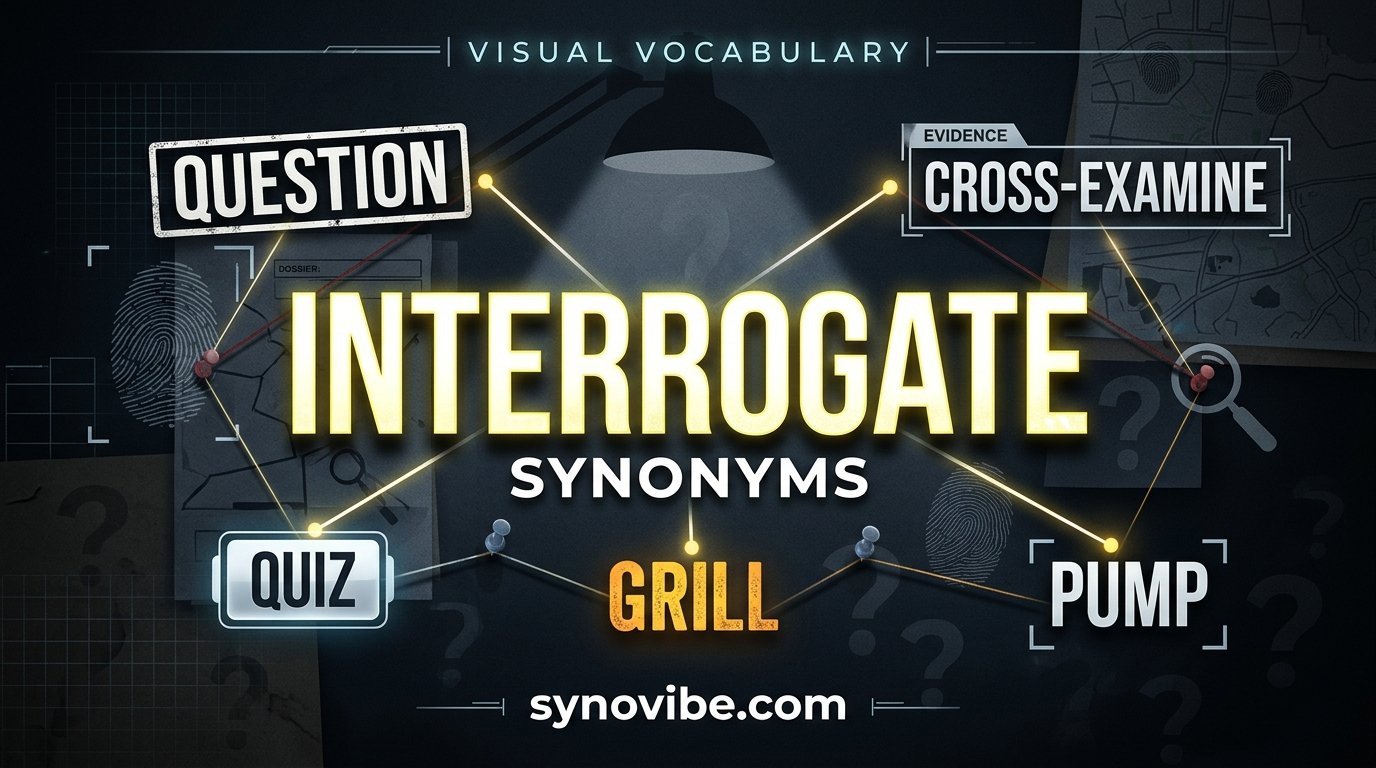
The most common synonyms for interrogate are question, examine, interview, cross-examine, quiz, and grill. These words describe asking someone questions to obtain information, clarify facts, or investigate a situation.
The best alternative depends on the context. Use question for general inquiries, interview for structured conversations, cross-examine for legal questioning, and grill for intense or persistent questioning.
Meaning and Usage of Interrogate
What Does Interrogate Mean?
The verb interrogate means to ask someone a series of questions, usually to discover information, establish facts, or investigate something.
It is often used in police investigations, legal proceedings, security situations, and formal inquiries. It can also describe situations in which someone asks another person many questions to understand what happened.
Simple definition: To interrogate someone means to ask questions to obtain information, often in a formal or intense way.
Example sentence: The detective interrogated the suspect about the missing documents.
In this sentence, interrogated suggests that the detective asked questions as part of an investigation.
How Is Interrogate Used in Everyday English?
Although interrogate is commonly associated with police investigations, it can also appear in everyday conversations.
For example:
- Formal: The investigators interrogated the witness about the incident.
- Professional: The manager questioned the employee about the missing report.
- Informal: My friends grilled me about my weekend plans.
- Academic: The researcher examined the evidence before reaching a conclusion.
These examples demonstrate why choosing the right synonym matters. Each word communicates a slightly different purpose or tone.
Is Interrogate a Positive or Negative Word?
Interrogate is generally neutral in formal contexts, but it can sound intense, serious, or intimidating in ordinary conversation.
For example, saying “The police interrogated the suspect” is appropriate when describing an investigation. Saying “My teacher interrogated me about my homework” may suggest that the teacher asked many difficult questions.
If the questions were friendly or routine, asked, questioned, or interviewed may be more appropriate.
30 Synonyms for Interrogate with Meanings and Examples
The following 30 words include direct synonyms and closely related alternatives. Some are suitable replacements in particular contexts, while others describe different parts of the questioning or investigation process.
1. Question
Meaning: To ask someone for information or an explanation.
Example: The teacher questioned the student about the unfinished assignment.
Best usage/context: Everyday conversations, workplace discussions, interviews, and investigations.
Question is one of the most versatile alternatives to interrogate. It usually sounds less intense and can describe a single question or a series of questions.
2. Examine
Meaning: To inspect or study someone or something carefully.
Example: The lawyer examined the witness about the events of that evening.
Best usage/context: Legal discussions, formal inquiries, academic writing, and careful investigations.
Examine can replace interrogate when the emphasis is on systematic questioning. However, it can also mean inspecting an object, document, or piece of evidence.
3. Interview
Meaning: To ask someone questions to collect information or learn about their experience.
Example: The journalist interviewed the witness after the accident.
Best usage/context: Job applications, journalism, research, and information gathering.
An interview is generally more structured and less confrontational than an interrogation.
4. Cross-Examine
Meaning: To question a witness formally, especially during a legal proceeding.
Example: The defense attorney cross-examined the witness about the conflicting statements.
Best usage/context: Courtrooms, legal writing, and discussions about trials.
Cross-examine is a precise alternative when questioning takes place within a legal proceeding. It is not normally suitable for casual conversations.
5. Quiz
Meaning: To ask someone questions to test their knowledge or understanding.
Example: The instructor quizzed the students on the previous lesson.
Best usage/context: Education, training, revision, and informal testing.
Unlike interrogate, quiz usually focuses on checking knowledge rather than investigating suspected wrongdoing.
6. Grill
Meaning: To ask someone many questions persistently or intensely.
Example: The reporters grilled the spokesperson about the unexpected decision.
Best usage/context: Informal conversations, journalism, interviews, and demanding questioning.
Grill is a strong, conversational synonym that suggests pressure or persistence.
7. Probe
Meaning: To ask questions or investigate deeply to discover hidden information.
Example: The committee probed the reasons behind the financial irregularities.
Best usage/context: Investigations, research, journalism, and complex inquiries.
Probe emphasizes looking beneath the surface to understand the facts.
8. Investigate
Meaning: To examine a situation or event carefully to discover the truth.
Example: The officers investigated the circumstances surrounding the disappearance.
Best usage/context: Police work, workplace misconduct, scientific research, and formal inquiries.
Investigate is related to interrogate, but the two words are not interchangeable in every sentence. Investigation is the broader process, while interrogation specifically involves questioning.
9. Inquire
Meaning: To ask for information, usually in a polite or formal way.
Example: The manager inquired about the delay in delivering the order.
Best usage/context: Professional communication, formal requests, and polite conversations.
Inquire sounds more courteous and less confrontational than interrogate.
10. Interrogate Closely
Meaning: To question someone in considerable detail.
Example: The investigator interrogated the witness closely about the timeline.
Best usage/context: Formal investigations and situations requiring detailed questioning.
This is a phrase rather than a single-word synonym. It emphasizes the depth and detail of the questioning.
11. Scrutinize
Meaning: To examine something very carefully.
Example: The auditor scrutinized the financial records for inconsistencies.
Best usage/context: Reviewing evidence, checking documents, and evaluating information.
Scrutinize is more appropriate when the focus is on examining evidence rather than directly questioning a person.
12. Challenge
Meaning: To question or dispute a statement, decision, or claim.
Example: The journalist challenged the official’s explanation of the incident.
Best usage/context: Debates, interviews, discussions, and critical examination.
Challenge emphasizes doubt or disagreement rather than simply asking for information.
13. Confront
Meaning: To address someone directly about a problem or suspicious action.
Example: The supervisor confronted the employee about the unauthorized changes.
Best usage/context: Workplace disputes, personal disagreements, and direct questioning about problems.
Confront can involve questions, but it also suggests directly addressing a difficult issue.
14. Grill Intensively
Meaning: To question someone persistently and in great detail.
Example: The committee grilled the director intensively about the project’s rising costs.
Best usage/context: Informal descriptions of demanding questioning.
This phrase reinforces the pressure associated with grill. It is more conversational than formal or legal alternatives.
15. Cross-Question
Meaning: To ask someone additional or challenging questions, often to test an explanation.
Example: The reporter cross-questioned the spokesperson about the inconsistent figures.
Best usage/context: Challenging conversations, interviews, and questioning that tests a person’s account.
Cross-question is less universally used than question or cross-examine. In formal legal contexts, cross-examine is generally the more precise choice.
16. Interpellate
Meaning: To question a public official formally, particularly in a legislative setting.
Example: Opposition members interpellated the minister about the new policy.
Best usage/context: Parliamentary proceedings, political science, and formal political writing.
Interpellate is a specialized term and is not a natural substitute for interrogate in everyday English.
17. Debrief
Meaning: To ask someone for a report or explanation about an experience, assignment, or event.
Example: The team leader debriefed the employees after the emergency exercise.
Best usage/context: Workplace reviews, military settings, training exercises, and project discussions.
A debrief is generally intended to gather information and review events rather than pressure someone into answering.
18. Pump for Information
Meaning: To try to obtain information from someone by asking repeated questions.
Example: The reporter pumped the official for information about the negotiations.
Best usage/context: Informal conversations, journalism, and situations involving persistent information gathering.
This phrase can suggest that the person asking questions is eager to obtain details that the other person may not readily share.
19. Cross-Question Closely
Meaning: To question someone repeatedly to test the accuracy of an explanation.
Example: The investigator cross-questioned the witness closely about the sequence of events.
Best usage/context: Detailed questioning and situations in which answers need to be checked.
This is a descriptive phrase rather than a standard single-word synonym. Depending on the context, question closely or cross-examine may sound more natural.
20. Interrogate Formally
Meaning: To question someone through an organized or official process.
Example: Authorized investigators formally interrogated the suspect.
Best usage/context: Official investigations, legal reporting, and formal records.
This phrase emphasizes the official nature of the questioning rather than its intensity.
21. Question Closely
Meaning: To ask detailed questions about a particular subject.
Example: The editor questioned the author closely about the source of the statistics.
Best usage/context: Fact-checking, interviews, investigations, and professional discussions.
This is a natural alternative when someone needs precise answers or clarification.
22. Ask
Meaning: To request information or an answer from someone.
Example: The officer asked the witness what happened near the entrance.
Best usage/context: Everyday conversations, polite requests, and general information gathering.
Ask is the simplest and most neutral alternative. It does not imply pressure, suspicion, or a formal investigation.
23. Request an Explanation
Meaning: To ask someone to explain a decision, action, or situation.
Example: The supervisor requested an explanation for the missed deadline.
Best usage/context: Workplace communication, academic settings, and formal discussions.
This phrase is useful when the purpose of questioning is to understand why something happened.
24. Demand Answers
Meaning: To insist that someone provide information or explain a situation.
Example: The residents demanded answers about the sudden closure of the facility.
Best usage/context: Public disputes, tense conversations, and situations involving accountability.
This phrase suggests urgency or frustration and is stronger than ask or inquire.
25. Cross-Examine Thoroughly
Meaning: To question a witness in detail during a legal proceeding.
Example: The attorney cross-examined the witness thoroughly about the disputed agreement.
Best usage/context: Legal proceedings and formal descriptions of detailed courtroom questioning.
This phrase emphasizes the depth of the legal examination. It should not be used for ordinary questioning unless the context supports the comparison.
26. Interrogate Aggressively
Meaning: To question someone in a forceful or confrontational manner.
Example: The reporter aggressively questioned the spokesperson about the allegations.
Best usage/context: Describing intense questioning in journalism, investigations, or disputes.
This phrase describes the manner of questioning rather than offering a separate, exact synonym. Question aggressively is often more natural in ordinary English.
27. Challenge with Questions
Meaning: To ask questions that test a person’s claims or reasoning.
Example: The professor challenged the speaker with questions about the proposed solution.
Best usage/context: Academic discussions, debates, presentations, and critical interviews.
This phrase is useful when questions are designed to test an argument rather than uncover suspected wrongdoing.
28. Seek Clarification
Meaning: To ask for additional information to make something easier to understand.
Example: The employee sought clarification about the new reporting requirements.
Best usage/context: Professional communication, education, instructions, and collaborative discussions.
Unlike interrogate, this phrase usually sounds polite and cooperative.
29. Elicit Information
Meaning: To obtain information through questions, conversation, or another method.
Example: The researcher used follow-up questions to elicit information from participants.
Best usage/context: Research, interviews, investigations, and formal writing.
Elicit focuses on obtaining a response or information. It does not necessarily imply intense questioning.
30. Extract Information
Meaning: To obtain information from someone or something, sometimes with difficulty.
Example: The investigator struggled to extract information from the incomplete records and reluctant witnesses.
Best usage/context: Investigations, analytical writing, and situations involving difficult information gathering.
When applied to a person, extract information may suggest pressure or reluctance. When applied to records or data, it simply describes retrieving useful details.
Comparison Table: Which Interrogate Synonym Should You Use?
The following table compares useful alternatives according to their meaning, tone, and typical context.
| Synonym | Tone | Main Purpose | Best Context |
| Question | Neutral | Obtain an answer | Everyday conversations |
| Examine | Formal | Study or question carefully | Legal and academic settings |
| Interview | Professional | Gather information | Jobs, journalism, research |
| Cross-examine | Formal and intense | Test a witness’s account | Court proceedings |
| Quiz | Casual or educational | Test knowledge | Schools and training |
| Grill | Informal and intense | Ask persistent questions | Interviews and discussions |
| Probe | Investigative | Discover deeper information | Inquiries and research |
| Investigate | Formal | Discover facts | Police work and audits |
| Inquire | Polite and formal | Request information | Professional communication |
| Scrutinize | Analytical | Examine closely | Documents and evidence |
| Challenge | Assertive | Test or dispute a claim | Debates and interviews |
| Confront | Direct | Address a problem | Disputes and misconduct |
| Interpellate | Specialized | Question an official | Parliamentary settings |
| Debrief | Professional | Review events | Workplace and training |
| Ask | Neutral | Request information | General conversation |
| Seek clarification | Polite | Resolve confusion | Work and education |
| Elicit information | Formal | Obtain information | Research and interviews |
| Extract information | Potentially forceful | Obtain difficult information | Investigations |
Quick recommendation: Choose question for general use, interview for structured conversations, cross-examine for legal questioning, probe for deeper investigation, and grill for persistent questioning.
Remember that words such as investigate, scrutinize, and debrief are related alternatives rather than exact replacements in every sentence.
How to Choose the Right Synonym for Interrogate
Choosing the right word depends on your intended meaning, the relationship between the people involved, and the formality of the situation.
1. Choose According to Tone
The tone of a synonym affects how readers understand the situation.
For a neutral tone:
- Ask
- Question
- Inquire
Example: The manager asked the employee about the schedule.
These words are appropriate when the conversation does not involve pressure or suspicion.
For a formal tone:
- Examine
- Interview
- Probe
Example: The committee examined the evidence before publishing its findings.
These words work well in professional, academic, and investigative writing.
For an intense tone:
- Grill
- Cross-examine
- Demand answers
Example: The journalists grilled the spokesperson about the controversial announcement.
These expressions suggest pressure, persistence, or a need for accountability.
2. Choose According to Meaning
Different synonyms emphasize different purposes.
When you want information: Use ask, question, or inquire.
When you want to test knowledge: Use quiz.
When you want to examine a claim: Use challenge or scrutinize.
When you want to uncover hidden facts: Use probe or investigate.
When you want to test a witness’s statement in court: Use cross-examine.
When you want to understand why something happened: Use request an explanation.
For example, “The scientist investigated the results” describes a broader process than “The scientist questioned the participant.”
3. Choose According to Intent
Consider what the person asking questions wants to accomplish.
| Intent | Recommended Word | Example |
| Obtain basic information | Ask | She asked him about the meeting. |
| Clarify a confusing point | Question | The teacher questioned the student’s interpretation. |
| Gather professional information | Interview | The journalist interviewed the researcher. |
| Test a legal statement | Cross-examine | The attorney cross-examined the witness. |
| Discover deeper facts | Probe | The committee probed the allegations. |
| Test someone’s knowledge | Quiz | The instructor quizzed the class. |
| Challenge an explanation | Confront | The manager confronted the supplier about the delay. |
| Request a polite explanation | Seek clarification | The student sought clarification about the instructions. |
4. Consider Your Audience
The best synonym also depends on who will read your writing.
For an academic essay, examine, investigate, or scrutinize may be suitable.
For a news report, question, interview, or probe may communicate the situation more naturally.
For an informal story, grill may convey tension or humor.
For a legal document, use precise terminology such as interrogate or cross-examine when the facts and procedural context support it.
5. Check the Sentence Before Replacing the Word
Not every synonym fits the same grammatical structure.
For example:
- Original: The detective interrogated the suspect.
- Alternative: The detective questioned the suspect.
- Alternative: The detective interviewed the witness.
The first two sentences can describe similar actions, although interrogated usually sounds more formal or intense. The third sentence may describe a different process, depending on the purpose of the conversation.
Always consider the meaning of the complete sentence rather than replacing one word automatically.
Common Mistakes When Using Interrogate Synonyms
Even closely related words can communicate different ideas. Avoid these common mistakes to make your writing more accurate.
1. Treating Every Synonym as an Exact Replacement
Investigate and interrogate are related, but they describe different actions.
Incorrect: The detective interrogated the crime scene.
Better: The detective investigated the crime scene.
A detective may interrogate a person, but generally investigates a scene.
2. Using Cross-Examine Outside Its Proper Context
Cross-examine has a specific legal meaning.
Awkward: I cross-examined my friend about his vacation.
More natural: I questioned my friend about his vacation.
You can use grilled if you want to suggest that you asked many persistent questions.
3. Using Interrogate When Ask Is More Appropriate
Interrogate may sound unnecessarily serious in ordinary situations.
Awkward: I interrogated my colleague about the lunch menu.
More natural: I asked my colleague about the lunch menu.
Reserve interrogate for contexts in which formal, intensive, or investigative questioning is intended.
4. Confusing Interview with Interrogation
An interview is often designed to collect information, understand experience, or evaluate suitability. An interrogation generally emphasizes obtaining information through formal or intensive questioning.
For example:
- The company interviewed three applicants.
- The police interrogated the suspect.
The words reflect different purposes and settings.
5. Confusing Elicit with Illicit
These words sound similar but have different meanings.
- Elicit: To draw out a response or information.
- Illicit: Illegal or prohibited.
Correct: The researcher used questions to elicit honest responses.
Incorrect: The researcher used questions to illicit honest responses.
Remembering this distinction will help you avoid a common vocabulary error.
6. Choosing a Strong Word for a Polite Situation
Words such as grill, confront, and demand answers can make a conversation sound tense.
If you simply want more information, use ask, inquire, or seek clarification instead.
7. Ignoring Grammar and Word Form
The word interrogate is a verb, while interrogation is a noun and interrogative is an adjective or noun depending on its use.
Examples:
- Verb: The officer interrogated the suspect.
- Noun: The interrogation lasted several hours.
- Adjective: The sentence has an interrogative structure.
Choose the appropriate word form to keep your sentence grammatically correct.
FAQs:
1. What Is the Best Synonym for Interrogate?
The best general synonym for interrogate is question. Other suitable choices include examine, interview, probe, grill, and cross-examine. The right option depends on whether the questioning is casual, professional, investigative, or legal.
2. What Is a Simple Word for Interrogate?
The simplest alternative is ask. For example, “The teacher interrogated the student” can become “The teacher questioned the student.” If the conversation is friendly or routine, “The teacher asked the student” may sound more natural.
3. What Is a Stronger Word for Interrogate?
Grill is a strong informal alternative that suggests persistent questioning. Cross-examine is appropriate for formal legal questioning, while press for answers emphasizes the effort to obtain information.
These expressions are not interchangeable in every situation.
4. Is Question the Same as Interrogate?
Not exactly. Question can refer to asking one simple question or requesting information in a neutral way. Interrogate usually suggests a more systematic, formal, or intense series of questions.
For example, a teacher may question a student about an answer without interrogating them.
5. What Is the Difference Between Interrogate and Investigate?
Interrogate means to ask someone questions to obtain information. Investigate means to examine a situation, event, or evidence to discover facts.
For example, police officers may investigate a burglary and interrogate a suspect as part of that investigation.
6. What Is the Difference Between Interrogate and Interview?
An interview is generally a structured conversation used to gather information or assess someone’s experience. An interrogation usually involves more focused or intensive questioning intended to establish facts or obtain information.
The distinction depends on the circumstances, but interview often sounds less confrontational.
7. Can Interrogate Be Used in Everyday English?
Yes. The word can be used informally to describe someone asking many questions. For example, “My family interrogated me about my travel plans.”
However, this wording can sound humorous or suggest that the questions felt intense. For ordinary conversations, asked or questioned may be more suitable.
8. What Is the Noun Form of Interrogate?
The noun form is interrogation. It refers to the act or process of asking someone questions, especially in a formal or investigative setting.
Example: “The interrogation helped investigators clarify the timeline.”
The related noun interrogator refers to a person who conducts an interrogation.
Conclusion
Choosing the right interrogate synonym helps you communicate more clearly and accurately. Although question, examine, interview, probe, and grill share connections with interrogate, each word has a different meaning, tone, or purpose.
Use question for general information gathering, interview for structured conversations, cross-examine for legal proceedings, and probe when emphasizing a deeper search for facts. Choose grill when you want to describe persistent or intense questioning.
Remember that a good synonym should preserve the meaning of your sentence while matching its tone and context. By understanding these distinctions and practicing the examples in this guide, you can expand your vocabulary and communicate more confidently in academic, professional, and everyday English.

Lucas Reed is a content writer interested in vocabulary, synonyms, and effective word choice. He creates accessible, informative content to help readers understand similar words, explore alternative expressions, and make their writing clearer and more engaging.