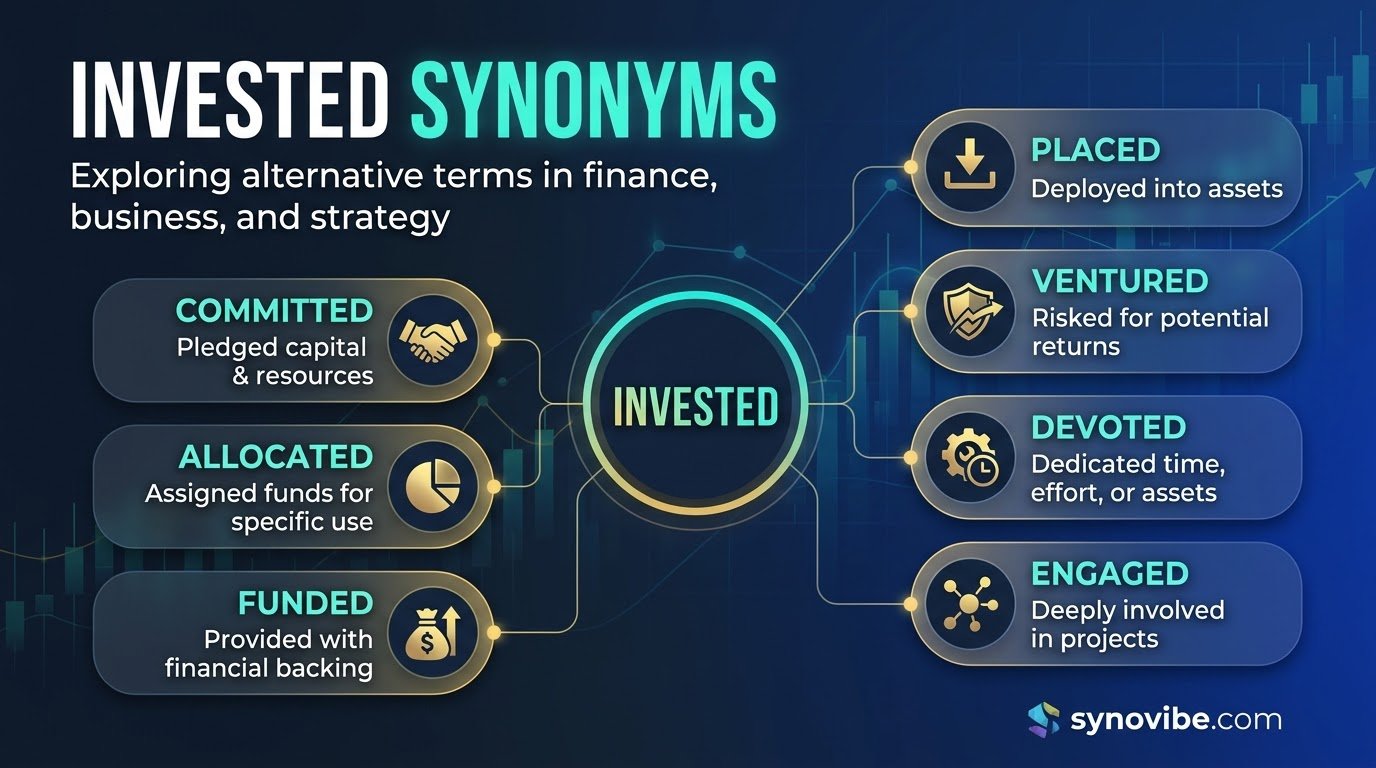
The best invested synonyms include committed, dedicated, involved, devoted, engaged, and contributed, depending on the context. The word invested can describe putting money into something, giving time and effort to a goal, or caring deeply about a person or outcome. Choosing the right alternative helps you communicate more clearly in academic writing, professional conversations, business discussions, and everyday English.
In this guide, you will discover 30 synonyms for invested, with simple meanings, practical example sentences, and explanations of when to use each word. You will also learn the differences between financial investment, emotional commitment, and personal involvement.
Quick Answer: What Is Another Word for Invested?
The best synonym for invested depends on how you use it.
- Financial context: Funded, financed, backed, or contributed.
- Time and effort: Committed, dedicated, devoted, or engaged.
- Emotional context: Involved, attached, caring, or devoted.
- Business context: Funded, backed, financed, or committed.
- Personal goals: Dedicated, determined, committed, or focused.
- Interest in an outcome: Concerned, engaged, or involved.
Example: Instead of saying, “She was invested in the project,” you could say, “She was committed to the project.”
However, if you mean that she provided money, funded or financed might be more accurate.
Meaning and Usage of Invested
The word invested is the past tense and past participle of the verb invest. It has several meanings depending on the situation.
1. Invested as a Financial Term
In financial contexts, invested means putting money into a business, property, project, or financial asset with the expectation of receiving a benefit or return.
Example: The company invested $50,000 in new technology.
Possible synonyms include:
- Funded
- Financed
- Backed
- Contributed
- Put money into
These words are not always interchangeable. For example, funded emphasizes providing money, while invested often suggests an expectation of future benefits or returns.
2. Invested as a Sign of Commitment
When someone gives significant time, energy, or attention to an activity, they may be described as invested in it.
Example: He is deeply invested in his students’ success.
Possible synonyms include:
- Committed
- Dedicated
- Devoted
- Engaged
- Involved
In this context, invested often suggests that someone cares about the outcome and is willing to make an effort to achieve it.
3. Invested as an Emotional Expression
The word can also describe emotional involvement in a relationship, decision, or personal situation.
Example: She became emotionally invested in the story’s characters.
Possible alternatives include:
- Attached
- Devoted
- Involved
- Engaged
- Caring
The exact choice depends on the intended meaning. Attached emphasizes an emotional connection, while devoted suggests strong loyalty or dedication.
4. Invested as an Expression of Interest
Someone who is interested in a particular outcome may also be described as invested in it.
Example: The community is invested in the success of the local school.
In this sentence, the community cares about the school’s future and has a reason to support its success.
Possible alternatives include concerned, interested, involved, and engaged. These words express different levels of interest and participation.
30 Synonyms for Invested: Meanings, Examples, and Best Uses
The following 30 words cover financial investment, personal commitment, emotional involvement, and interest in an outcome. Some are close synonyms, while others are suitable alternatives only in particular contexts.
1. Committed
Simple meaning: Dedicated to a goal, responsibility, or promise.
Example: Maria is committed to improving her writing skills.
Best usage/context: Use committed when someone takes a goal seriously and intends to continue working toward it.
Why it works: It is one of the best general alternatives to invested when describing dedication and responsibility.
2. Dedicated
Simple meaning: Giving time, attention, and effort to something important.
Example: The dedicated teacher spends extra time helping struggling students.
Best usage/context: Use dedicated in educational, professional, and personal contexts where consistent effort matters.
Why it works: It emphasizes willingness to work hard toward a goal.
3. Devoted
Simple meaning: Showing deep love, loyalty, or commitment.
Example: He is devoted to his family and their well-being.
Best usage/context: Use devoted when describing strong personal loyalty, affection, or dedication.
Why it works: It often conveys a stronger emotional connection than committed.
4. Involved
Simple meaning: Taking part in something or having a connection to it.
Example: Several parents are involved in organizing the school festival.
Best usage/context: Use involved when someone participates in an activity, relationship, or project.
Why it works: It is a useful alternative when invested means actively participating rather than providing money.
5. Engaged
Simple meaning: Actively interested in or participating in something.
Example: The students remained engaged throughout the discussion.
Best usage/context: Use engaged in education, workplace communication, and conversations about attention or participation.
Why it works: It emphasizes active attention and involvement.
6. Dedicatedly
Simple meaning: In a dedicated manner, with commitment and effort.
Example: The team worked dedicatedly to complete the community project.
Best usage/context: This adverb is intended to describe committed effort, but it is less natural than alternatives such as diligently or with dedication.
Why it works: It can express the manner of working, although it is not a direct replacement for the adjective invested.
Usage note: In most modern English writing, prefer “The team worked diligently” or “The team worked with dedication.”
7. Focused
Simple meaning: Giving attention to a particular goal or task.
Example: She remained focused on completing her research paper.
Best usage/context: Use focused when the main idea is concentration and attention.
Why it works: It describes someone directing their energy toward a specific outcome.
8. Determined
Simple meaning: Firmly intending to achieve something.
Example: He is determined to build a successful business.
Best usage/context: Use determined when emphasizing persistence and a strong desire to succeed.
Why it works: It highlights the intention to overcome difficulties rather than the act of investing resources.
9. Passionate
Simple meaning: Having strong enthusiasm or interest.
Example: She is passionate about protecting endangered animals.
Best usage/context: Use passionate to describe strong feelings about a subject, activity, or cause.
Why it works: It is useful when invested refers to emotional enthusiasm.
10. Enthusiastic
Simple meaning: Showing excitement and eagerness.
Example: The employees were enthusiastic about the new training program.
Best usage/context: Use enthusiastic when someone expresses positive energy or excitement.
Why it works: It emphasizes interest and excitement, although it does not necessarily imply long-term commitment.
11. Committed to
Simple meaning: Firmly dedicated to a particular person, cause, or goal.
Example: The organization is committed to improving access to education.
Best usage/context: Use this phrase in formal writing, workplace communication, and discussions about responsibilities.
Why it works: It provides a natural alternative to “invested in” when describing a clear dedication.
12. Attached
Simple meaning: Emotionally connected to someone or something.
Example: She became attached to the small town where she grew up.
Best usage/context: Use attached when describing emotional bonds with people, places, or experiences.
Why it works: It conveys personal feelings rather than financial or practical participation.
13. Concerned
Simple meaning: Interested in or worried about a particular situation or outcome.
Example: The residents are concerned about the future of their neighborhood.
Best usage/context: Use concerned when someone cares about an issue, especially when it involves possible problems.
Why it works: It can replace invested when the intended meaning is caring about what happens.
Important distinction: Concerned may suggest worry, while invested does not necessarily imply anxiety.
14. Interested
Simple meaning: Wanting to learn about or pay attention to something.
Example: Daniel is interested in learning more about renewable energy.
Best usage/context: Use interested when describing curiosity or attention.
Why it works: It is suitable when invested means mentally interested in a topic.
Important distinction: Being interested does not necessarily mean making a significant commitment.
15. Participating
Simple meaning: Taking part in an activity or event.
Example: More than 100 students are participating in the science competition.
Best usage/context: Use participating when someone actively takes part in an event, project, or activity.
Why it works: It emphasizes action rather than emotional attachment or financial involvement.
16. Active
Simple meaning: Taking action or participating regularly.
Example: She is an active member of the environmental club.
Best usage/context: Use active when describing regular participation in a group or activity.
Why it works: It can communicate involvement, especially when someone’s investment is demonstrated through ongoing action.
17. Diligent
Simple meaning: Careful, hardworking, and consistent.
Example: The diligent researcher checked every reference before publishing the report.
Best usage/context: Use diligent in academic and professional contexts where careful effort is important.
Why it works: It describes the quality of someone’s work rather than their emotional investment.
18. Hardworking
Simple meaning: Willing to work hard and put in effort.
Example: The hardworking team completed the project ahead of schedule.
Best usage/context: Use hardworking when highlighting effort, persistence, and productivity.
Why it works: It is suitable when being invested in something means working seriously toward its success.
19. Committed-minded
Simple meaning: Intended to describe someone who approaches responsibilities with commitment.
Example: The committed-minded volunteers continued helping the community throughout the year.
Best usage/context: The phrase may be understandable, but it is not a common or natural English expression.
Why it works: It communicates the intended idea, but more natural alternatives include committed, dedicated, and goal-oriented.
Usage note: Prefer “The committed volunteers continued helping the community.”
20. Goal-oriented
Simple meaning: Focused on achieving specific objectives.
Example: Our goal-oriented team developed a clear plan for increasing customer satisfaction.
Best usage/context: Use goal-oriented in business, education, career planning, and personal development.
Why it works: It describes people who direct their efforts toward measurable outcomes.
21. Purposeful
Simple meaning: Acting with a clear aim or intention.
Example: She took a purposeful approach to improving her communication skills.
Best usage/context: Use purposeful when emphasizing intentional action and a clear direction.
Why it works: It can describe the way someone invests time and effort in a meaningful goal.
22. Devotedly
Simple meaning: In a loyal, loving, or dedicated manner.
Example: He worked devotedly to support the community project.
Best usage/context: Use this adverb when describing the manner in which someone performs an action.
Why it works: It expresses dedication, particularly when loyalty or personal commitment is important.
Important distinction: Devotedly describes how someone acts; it cannot directly replace the adjective invested in every sentence.
23. Backed
Simple meaning: Supported, often with money, resources, or approval.
Example: The startup was backed by several experienced investors.
Best usage/context: Use backed in business, finance, entrepreneurship, and discussions about support.
Why it works: It is especially useful when someone provides financial or practical support.
24. Funded
Simple meaning: Provided with money to support an activity or project.
Example: The research program was funded by a charitable foundation.
Best usage/context: Use funded when emphasizing the source of financial support.
Why it works: It is a precise alternative when invested refers to supplying money.
Important distinction: Funding does not always involve an expectation of financial profit.
25. Financed
Simple meaning: Provided money for something or arranged the money needed to pay for it.
Example: The company financed the construction of its new warehouse.
Best usage/context: Use financed in business, property, education, and project-related financial discussions.
Why it works: It emphasizes how an activity or purchase receives financial support.
26. Contributed
Simple meaning: Gave money, time, effort, or resources to help achieve something.
Example: Many local businesses contributed money to the community center.
Best usage/context: Use contributed when describing donations, shared effort, or participation in a collective goal.
Why it works: It is a useful alternative when someone provides resources without necessarily expecting a financial return.
27. Allocated
Simple meaning: Set aside resources for a specific purpose.
Example: The manager allocated additional funds to the training program.
Best usage/context: Use allocated in budgets, project planning, management, and resource distribution.
Why it works: It describes assigning money, time, or resources to a particular task.
Important distinction: Allocating resources does not necessarily mean investing them in the financial sense.
28. Placed
Simple meaning: Put something in a particular position or situation.
Example: The investor placed a portion of her savings in a low-risk fund.
Best usage/context: Use placed in specific expressions about putting money into an account, fund, or investment.
Why it works: It can replace invested in some financial sentences, although it is less precise on its own.
29. Immersed
Simple meaning: Deeply involved in an activity, subject, or experience.
Example: He became immersed in learning a new language.
Best usage/context: Use immersed when someone gives sustained attention to an activity or experience.
Why it works: It conveys a strong level of mental involvement and concentration.
Important distinction: Being immersed in an activity does not necessarily mean having a personal stake in its outcome.
30. Committed to the Outcome
Simple meaning: Strongly concerned with achieving a particular result.
Example: The project manager is committed to the outcome and works closely with the entire team.
Best usage/context: Use this phrase in leadership, project management, teamwork, and professional communication.
Why it works: It emphasizes responsibility for results rather than simply participating in an activity.
Important distinction: This is a descriptive phrase, not a single-word synonym.
Comparison Table: Choosing the Best Synonym for Invested
Use this table to identify the most suitable alternative for your sentence.
| Synonym | Main Meaning | Best Context | Example |
| Committed | Dedicated to a goal | Personal and professional goals | She is committed to her education. |
| Dedicated | Giving consistent effort | Work and study | He is dedicated to his research. |
| Devoted | Showing strong loyalty or affection | Relationships and causes | She is devoted to her family. |
| Involved | Taking part or having a connection | Projects and activities | They are involved in the campaign. |
| Engaged | Actively interested | Learning and teamwork | The audience remained engaged. |
| Focused | Directing attention toward a goal | Tasks and objectives | He is focused on his career. |
| Determined | Firmly intending to succeed | Challenges and ambitions | She is determined to succeed. |
| Passionate | Showing strong enthusiasm | Interests and causes | He is passionate about music. |
| Attached | Emotionally connected | Relationships and places | She is attached to her hometown. |
| Interested | Curious or attentive | Learning and exploration | They are interested in science. |
| Concerned | Caring or worried about an issue | Problems and outcomes | We are concerned about safety. |
| Goal-oriented | Focused on objectives | Business and personal development | The team is goal-oriented. |
| Diligent | Careful and hardworking | Academic and professional tasks | She is a diligent student. |
| Immersed | Deeply involved in an experience | Learning and creative work | He is immersed in the project. |
| Backed | Supported with resources | Business and finance | The startup is backed by investors. |
| Funded | Supplied with money | Research and projects | The study was funded by a grant. |
| Financed | Money provided or arranged | Business and purchases | The company financed the expansion. |
| Contributed | Gave resources or effort | Donations and teamwork | She contributed to the project. |
| Allocated | Assigned resources | Budgets and planning | Funds were allocated to research. |
| Participating | Taking part | Events and activities | They are participating in the program. |
How to Choose the Right Synonym for Invested
The best alternative depends on what you want to communicate. Consider the tone, meaning, and purpose of your sentence before choosing a replacement.
1. Choose According to Tone
Different synonyms create different impressions.
For formal or professional writing:
- Committed
- Dedicated
- Engaged
- Goal-oriented
- Allocated
Example: “The organization is committed to improving workplace safety.”
For friendly, everyday English:
- Interested
- Involved
- Focused
- Enthusiastic
- Hardworking
Example: “I’m really interested in how this project turns out.”
For emotional or personal writing:
- Devoted
- Attached
- Passionate
- Immersed
- Concerned
Example: “She became emotionally attached to the characters.”
For business and financial writing:
- Funded
- Financed
- Backed
- Contributed
- Allocated
Example: “The company funded the development of a new product.”
2. Choose According to Meaning
First, identify the meaning of invested in your original sentence.
If it means putting money into something, consider funded, financed, or backed.
Original: “The entrepreneur invested in a new business.”
Alternative: “The entrepreneur funded a new business.”
The second sentence emphasizes providing financial resources. It does not necessarily communicate the expectation of a financial return as clearly as invested does.
If it means giving time and effort, consider committed, dedicated, or diligent.
Original: “She is invested in her education.”
Alternative: “She is dedicated to her education.”
Both sentences communicate a serious commitment to learning.
If it means caring about someone or something, consider devoted, attached, or concerned.
Original: “He is invested in his children’s future.”
Alternative: “He is devoted to his children’s future.”
The alternative emphasizes dedication and care.
If it means participating actively, consider involved, engaged, or participating.
Original: “The employees are invested in the project.”
Alternative: “The employees are actively involved in the project.”
The alternative emphasizes participation rather than a personal stake in the outcome.
3. Choose According to Intent
Your purpose also determines which word works best.
| Your Intended Message | Recommended Word | Example |
| Someone takes a responsibility seriously | Committed | She is committed to her role. |
| Someone gives consistent effort | Dedicated | He is dedicated to his studies. |
| Someone feels a strong emotional bond | Attached | She is attached to the family home. |
| Someone actively participates | Involved | They are involved in the initiative. |
| Someone pays close attention | Engaged | The class is engaged in the lesson. |
| Someone provides money | Funded | The organization funded the program. |
| Someone provides financial support | Backed | Investors backed the company. |
| Someone cares about a result | Concerned | Residents are concerned about the outcome. |
| Someone focuses on a target | Goal-oriented | The team is goal-oriented. |
| Someone becomes deeply involved | Immersed | She is immersed in her research. |
4. Check the Grammar Before Replacing Invested
The word invested often appears in particular grammatical patterns.
Invested in + noun
- Original: She is invested in her career.
- Alternative: She is committed to her career.
Notice that invested in becomes committed to. A good replacement may require changing the preposition.
Invested time in + activity
- Original: He invested time in learning Spanish.
- Alternative: He devoted time to learning Spanish.
The natural replacement is devoted time to, not “devoted time in.”
Invested money in + asset
- Original: They invested money in the company.
- Alternative: They put money into the company.
This alternative is natural in everyday English, although it may not communicate the same financial expectations as invested.
Common Mistakes When Using Invested Synonyms
Choosing a synonym without checking its exact meaning can make a sentence unclear or unnatural. Avoid these common mistakes.
1. Treating Every Synonym as an Exact Replacement
Words that share a general meaning may communicate different ideas.
Incorrect assumption: Interested always means the same as invested.
Example:
- “I’m interested in the project” means the project attracts my attention.
- “I’m invested in the project” may mean I care about its success or have contributed substantial resources.
Tip: Use interested for curiosity and invested when the connection or commitment is stronger.
2. Confusing Financial Investment With Emotional Commitment
Financial and emotional meanings are not identical.
Example:
- “She invested in the company” usually refers to a financial contribution.
- “She was emotionally invested in the company” describes her personal attachment to its success.
Tip: Include words such as financially or emotionally when the distinction matters.
3. Using Funded When You Mean Personally Committed
Funded means that money was provided for something. It does not necessarily mean the person who supplied the money is emotionally involved or personally dedicated.
Example:
- “The foundation funded the project” is correct when the foundation provided money.
- “The foundation was dedicated to the project” describes its commitment or purpose.
Tip: Choose funded for financial support and dedicated for commitment.
4. Confusing Involved With Invested
Someone can be involved in an activity without caring deeply about its outcome.
Example:
- “He was involved in the event” means he participated or had a role.
- “He was invested in the event’s success” suggests that its outcome mattered to him.
Tip: Use involved for participation and invested for a stronger personal stake when that distinction is important.
5. Ignoring the Sentence Structure
Some synonyms require different prepositions or grammatical forms.
Incorrect: “She is dedicated in her education.”
Correct: “She is dedicated to her education.”
Similarly, you would normally say:
- Interested in a subject
- Committed to a goal
- Devoted to a cause
- Involved in a project
- Focused on a task
Tip: Learn common word combinations instead of replacing individual words without adjusting the sentence.
6. Choosing an Unnatural Expression
Not every understandable phrase sounds natural to fluent English speakers.
For example, committed-minded is not a common substitute for invested.
Instead of writing, “He is committed-minded about his career,” write:
“He is committed to his career.”
Tip: Prefer familiar expressions that communicate your meaning clearly.
FAQs:
1. What is the best synonym for invested?
The best general synonym is committed when describing dedication to a goal or activity. Other useful alternatives include dedicated, involved, devoted, and engaged. For financial contexts, funded, financed, and backed may be more appropriate.
2. What is another word for invested in someone?
Depending on the intended meaning, you can use devoted, attached, committed, caring, or emotionally involved.
For example, “She is invested in her friend’s success” could become “She is committed to supporting her friend’s success.”
If you mean a close emotional connection, “She is emotionally attached to her friend” may be more accurate.
3. What is a synonym for invested in a project?
Good alternatives include committed to, dedicated to, involved in, and engaged in.
For example:
“Everyone is invested in the project.”
You could write:
“Everyone is committed to the project’s success.”
The second version emphasizes the team’s dedication to achieving a positive result.
4. What is another word for financially invested?
Depending on the sentence, suitable alternatives include funded, financed, backed, and contributed to.
For example:
“The company invested in the research.”
Alternative:
“The company funded the research.”
Remember that these words can have different financial implications. Invested often suggests an expectation of a return or benefit, while funded simply emphasizes providing money.
5. What is a synonym for emotionally invested?
Common alternatives include emotionally attached, deeply involved, devoted, and personally committed.
For example:
“She was emotionally invested in the outcome.”
Alternative:
“She cared deeply about the outcome.”
The best choice depends on whether you want to emphasize attachment, dedication, or personal concern.
6. Is committed the same as invested?
Not exactly. Committed usually emphasizes dedication, responsibility, or a firm decision to support a goal. Invested can describe commitment, but it can also refer to money, time, effort, or emotional involvement.
For example, a person can be committed to a project without providing money, while an investor can put money into a company without being involved in its daily activities.
7. What is the opposite of invested?
The opposite depends on the context.
- Financial context: Withdrawn or divested may describe removing money or assets from an investment.
- Emotional context: Detached or uninvolved may describe a lack of emotional connection.
- Personal commitment: Uncommitted or disengaged may indicate a lack of dedication.
- Participation: Inactive or uninvolved may describe someone who does not participate.
For example, “She was emotionally invested in the decision” could be contrasted with “She remained emotionally detached from the decision.”
8. How can I use invested in a sentence?
Use invested to describe financial contributions, personal effort, or emotional commitment.
Examples:
- Financial: “They invested in a small technology company.”
- Personal: “He invested years in developing his skills.”
- Emotional: “She became invested in the characters’ lives.”
- Professional: “The manager is invested in the team’s success.”
The meaning becomes clearer when you consider what is being invested and why.
Conclusion
Choosing the right synonym for invested depends on the meaning you want to express. Words such as committed, dedicated, devoted, and involved work well when describing personal effort or commitment. In financial contexts, funded, financed, and backed may communicate the intended meaning more precisely.
For emotional situations, alternatives such as attached, caring, and emotionally involved can express a personal connection. Meanwhile, engaged, focused, and determined are useful when discussing attention, participation, or goals.
The key is to consider the context rather than choosing a replacement simply because it appears on a synonym list. By understanding the differences between these 30 alternatives, you can write more naturally, communicate more precisely, and expand your English vocabulary.

Henry Walker is a content writer who enjoys exploring vocabulary, word meanings, and the subtle differences between expressions. He creates clear, practical content to help readers discover useful synonyms and choose the most appropriate words for everyday writing and communication.