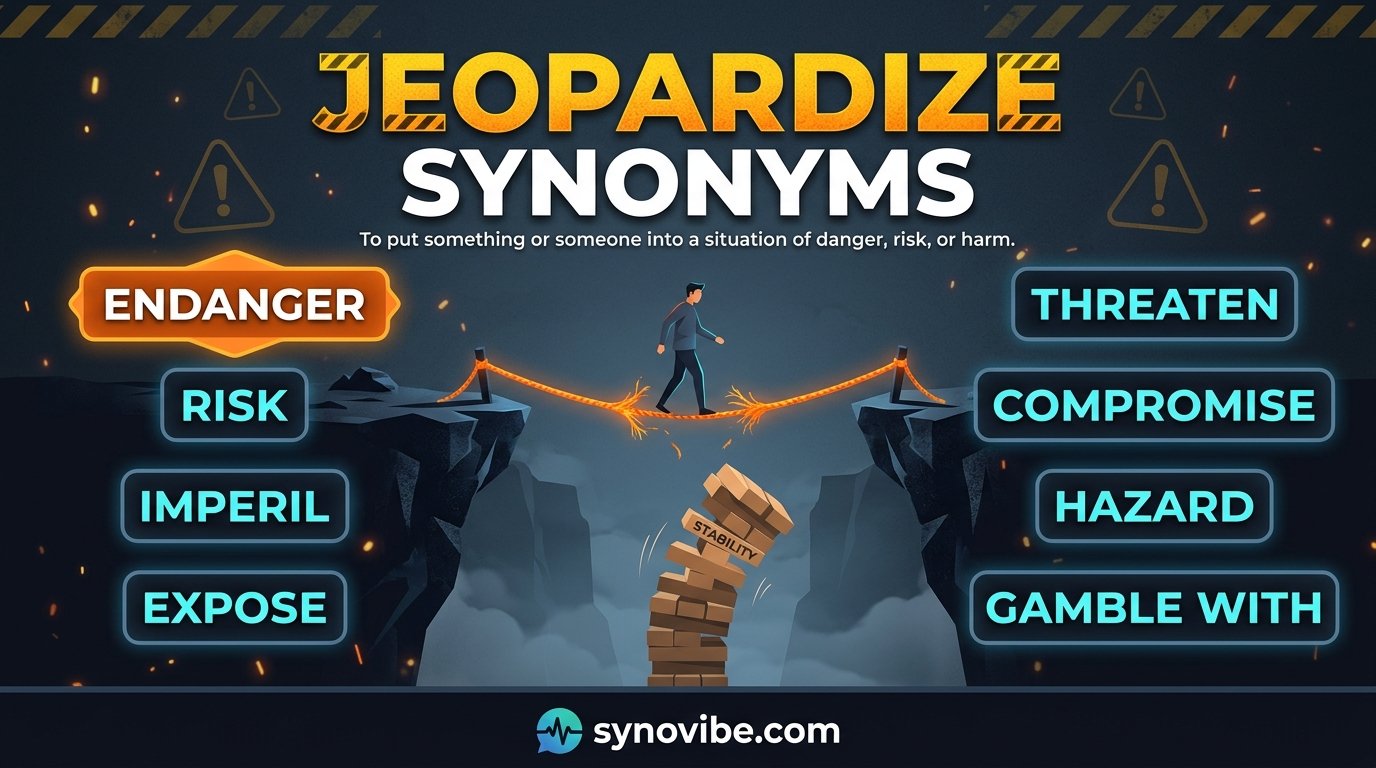
Are you looking for the best jeopardize synonym to improve your vocabulary, strengthen your writing, or express risk more clearly? The word jeopardize means to put someone or something in danger or create a risk of losing something valuable. Common synonyms include endanger, threaten, imperil, risk, compromise, and undermine.
Choosing the right synonym depends on the situation. For example, endanger emphasizes danger, risk highlights the possibility of a negative outcome, and undermine describes weakening something gradually. Understanding these differences helps you communicate more accurately in academic writing, professional conversations, essays, and everyday English.
In this guide, you will discover 30 alternatives to jeopardize, their simple meanings, practical example sentences, and the contexts in which each word works best.
Quick Answer: What Is a Synonym for Jeopardize?
The best synonym for jeopardize is endanger, which means to put someone or something at risk of harm, damage, or loss.
Other useful alternatives include:
- Threaten: To create a possibility of harm or loss.
- Imperil: To place someone or something in serious danger.
- Risk: To expose something valuable to possible loss.
- Compromise: To weaken or put something at risk.
- Endanger: To expose someone or something to danger.
- Undermine: To weaken something gradually.
- Hazard: To expose someone or something to danger, often through a risky action.
- Prejudice: To harm someone’s interests or chances of success.
- Jeopardize: To put something important in danger.
Example: Sharing confidential information could jeopardize your job.
You could also write, “Sharing confidential information could endanger your job” or “Sharing confidential information could put your job at risk.”
Although these alternatives are similar, their exact meanings and natural usage differ.
What Does Jeopardize Mean?
Jeopardize is a verb meaning to put something or someone in danger or increase the possibility of an undesirable result.
It often refers to situations in which a person’s safety, success, reputation, financial security, relationship, or future opportunity could be harmed.
Simple Definition
To jeopardize something means to do something that might cause it to fail, become unsafe, or be lost.
Examples of Jeopardize in Sentences
- Career: Repeatedly missing deadlines could jeopardize your career.
- Education: Cheating on an examination may jeopardize your academic future.
- Health: Ignoring serious symptoms could jeopardize your health.
- Relationships: Constant dishonesty can jeopardize a friendship.
- Business: Poor financial decisions might jeopardize the company’s future.
- Safety: Driving too quickly in heavy rain could jeopardize everyone’s safety.
In each example, an action creates a risk to something important.
Is Jeopardize Positive or Negative?
Jeopardize generally has a negative meaning because it describes putting something valuable at risk.
For instance:
- “She worked hard to protect her reputation” expresses a positive intention.
- “Her careless comments could jeopardize her reputation” emphasizes a possible negative consequence.
The word does not necessarily mean that harm has already happened. It indicates that something important could be damaged or lost.
Jeopardize vs. Jeopardise
Both jeopardize and jeopardise are correct spellings.
- Jeopardize: Commonly used in American English.
- Jeopardise: Commonly used in British English and other varieties that follow British spelling conventions.
Both words have the same meaning and pronunciation. Choose the spelling that matches your audience and use it consistently.
30 Synonyms for Jeopardize With Meanings and Examples
The following 30 words and expressions can help you replace jeopardize in different situations. Some are direct synonyms, while others express a related idea and work only in particular contexts.
1. Endanger
Meaning: To put someone or something in danger.
Example: Reckless driving can endanger the lives of innocent people.
Best usage/context: Use endanger when discussing physical safety, health, wildlife, or situations involving potential harm. It is one of the closest and most widely applicable synonyms for jeopardize.
2. Threaten
Meaning: To create a possibility of harm, damage, or loss.
Example: The sudden budget cuts threaten the future of several community programs.
Best usage/context: Use threaten when a person, event, decision, or condition creates a danger to something important. It works well in news articles, business reports, and everyday conversation.
3. Imperil
Meaning: To place someone or something in serious danger.
Example: Ignoring the safety regulations could imperil the entire construction project.
Best usage/context: Choose imperil for formal, serious, or dramatic situations. It is particularly useful in academic writing, journalism, and professional reports.
4. Risk
Meaning: To expose something valuable to the possibility of harm or loss.
Example: You could risk your scholarship by repeatedly missing classes.
Best usage/context: Use risk when someone knowingly or unknowingly exposes something to possible negative consequences. It is natural in everyday English and professional communication.
5. Compromise
Meaning: To weaken, damage, or put the safety or effectiveness of something at risk.
Example: Sharing your password could compromise the security of your account.
Best usage/context: Use compromise when discussing security, confidentiality, integrity, quality, or effectiveness. Unlike jeopardize, it can also describe something that has already been weakened.
6. Undermine
Meaning: To weaken something gradually or indirectly.
Example: Repeatedly breaking promises can undermine trust between friends.
Best usage/context: Choose undermine when an action weakens confidence, authority, relationships, credibility, or an established system. It often suggests gradual or hidden damage.
7. Hazard
Meaning: To expose someone or something to danger or risk.
Example: The hikers refused to hazard their safety by crossing the unstable bridge.
Best usage/context: Hazard can function as a verb, especially in formal or traditional expressions. It is less common than risk in ordinary conversation. As a noun, it usually means a source of danger, as in “a health hazard.”
8. Endangerment
Meaning: The act or state of putting someone or something in danger.
Example: The investigation focused on the endangerment of children caused by unsafe conditions.
Best usage/context: Endangerment is a noun, not a direct grammatical replacement for the verb jeopardize. Use it when discussing a condition, action, investigation, or legal concern involving danger.
9. Prejudice
Meaning: To harm someone’s interests, rights, or chances of success.
Example: A rushed decision could prejudice the company’s ability to negotiate a fair agreement.
Best usage/context: Use prejudice as a verb in formal, legal, or professional contexts when an action adversely affects someone’s interests. Its meaning differs from the more familiar noun referring to unfair attitudes toward people.
10. Damage
Meaning: To harm something or reduce its value, quality, or effectiveness.
Example: One careless statement could damage her professional reputation.
Best usage/context: Use damage when the emphasis is on harm itself rather than merely the possibility of harm. It can sometimes replace jeopardize, but it often suggests that negative effects have already occurred.
11. Endanger the safety of
Meaning: To put someone’s safety at risk.
Example: Leaving the emergency exit blocked could endanger the safety of everyone inside the building.
Best usage/context: Use this expression in safety instructions, workplace policies, and formal explanations where the specific concern is personal safety.
12. Put at risk
Meaning: To expose someone or something to possible harm or loss.
Example: Skipping important security updates may put your personal information at risk.
Best usage/context: This is a clear, natural alternative suitable for almost any audience. It works especially well when you want to explain the meaning of jeopardize in simple English.
13. Expose to danger
Meaning: To place someone or something in a situation where harm may occur.
Example: Entering the damaged building could expose workers to danger.
Best usage/context: Use this phrase when explaining how a particular action or condition creates a direct threat to safety or well-being.
14. Imperil the future of
Meaning: To put the future success or survival of something in danger.
Example: Poor leadership could imperil the future of the organization.
Best usage/context: This formal expression works well in business reports, political analysis, academic writing, and discussions about long-term plans.
15. Threaten the stability of
Meaning: To create a risk that something stable may become weak or disrupted.
Example: Frequent changes in management could threaten the stability of the department.
Best usage/context: Use this expression when discussing institutions, organizations, relationships, financial systems, or established arrangements.
16. Undercut
Meaning: To weaken the effectiveness, authority, or value of something.
Example: Making unsupported claims could undercut the credibility of your research.
Best usage/context: Choose undercut when an action reduces the strength or effectiveness of an argument, reputation, policy, or achievement. It is particularly useful in persuasive and professional writing.
17. Weaken
Meaning: To make something less strong, effective, or powerful.
Example: A lack of communication can weaken the relationship between team members.
Best usage/context: Use weaken when emphasizing a reduction in strength or effectiveness. It is a related alternative rather than an exact synonym because it does not always imply danger or possible loss.
18. Jeopardise
Meaning: To put something or someone at risk.
Example: Ignoring customer complaints could jeopardise the company’s reputation.
Best usage/context: Use jeopardise when writing in British English. It has exactly the same meaning as jeopardize and is simply a spelling variant.
19. Endanger the prospects of
Meaning: To put the chances of future success at risk.
Example: A weak application could endanger her prospects of receiving the scholarship.
Best usage/context: Use this expression when discussing career opportunities, academic applications, business growth, or future achievements.
20. Undermine the position of
Meaning: To weaken someone’s status, authority, or standing.
Example: The manager’s inconsistent decisions could undermine the position of the entire leadership team.
Best usage/context: This expression is appropriate for formal writing about leadership, negotiations, professional relationships, and institutional authority.
21. Jeopardize the chances of
Meaning: To reduce the likelihood of a desired outcome.
Example: Arriving late could jeopardize your chances of getting the job.
Best usage/context: Use this phrase when discussing goals, opportunities, competitions, applications, or other situations where success is uncertain.
22. Endanger the life of
Meaning: To place a person’s life in danger.
Example: Driving while severely distracted can endanger the life of a pedestrian.
Best usage/context: Use this expression when the specific concern is a threat to human life. It is more precise than jeopardize when physical survival is the main issue.
23. Threaten the existence of
Meaning: To create a serious risk that something may no longer exist.
Example: Continued habitat destruction could threaten the existence of several endangered species.
Best usage/context: This phrase is suitable for environmental discussions, organizational survival, endangered species, and long-term threats to established systems.
24. Endanger the integrity of
Meaning: To put the honesty, reliability, completeness, or soundness of something at risk.
Example: Altering the research results could endanger the integrity of the entire study.
Best usage/context: Use this expression in academic research, ethics discussions, data management, professional standards, and situations involving trustworthiness.
25. Destabilize
Meaning: To make something less stable or more likely to become disrupted.
Example: Sudden policy changes could destabilize the local economy.
Best usage/context: Choose destabilize when an action threatens the balance or stability of a system, organization, economy, government, or relationship.
Important distinction: Destabilize focuses on reducing stability. It does not always mean that something valuable will be lost.
26. Disrupt
Meaning: To interrupt the normal operation or progress of something.
Example: A major technical failure could disrupt the company’s daily operations.
Best usage/context: Use disrupt when emphasizing interruption, disorder, or interference. It can describe a way of jeopardizing a project or process, but not every disruption places something important at risk.
27. Impair
Meaning: To reduce the quality, ability, or effectiveness of something.
Example: A lack of sleep can impair your ability to concentrate during an examination.
Best usage/context: This word is useful in medical, academic, technical, and professional contexts. It focuses on reduced functioning rather than the broader possibility of loss.
28. Sabotage
Meaning: To deliberately damage, obstruct, or undermine something.
Example: Ignoring essential safety procedures could sabotage the team’s efforts to complete the project successfully.
Best usage/context: Use sabotage when an action seriously obstructs success. The word often implies deliberate interference, so it is not always appropriate when the risk is accidental.
29. Endanger the success of
Meaning: To put the successful completion or achievement of something at risk.
Example: Poor planning could endanger the success of the fundraising campaign.
Best usage/context: Use this phrase when discussing projects, events, business strategies, academic assignments, and other activities with a specific goal.
30. Put in jeopardy
Meaning: To place something in a dangerous or uncertain situation.
Example: The discovery of serious errors put the entire research project in jeopardy.
Best usage/context: This expression is especially useful in formal writing and everyday conversation when you want to emphasize that something important is now at risk.
Grammar note: Jeopardize is a verb, while jeopardy is a noun. You can say “The mistake could jeopardize the project” or “The mistake could put the project in jeopardy.”
Comparison Table: Jeopardize and Its Closest Synonyms
The best synonym depends on what is being threatened and how serious the potential consequences are.
| Synonym | Main Meaning | Tone | Best Context | Example |
| Endanger | Put in danger | Neutral | Safety and health | Speeding can endanger pedestrians. |
| Threaten | Create a possibility of harm | Neutral | General risks | The storm threatens the crops. |
| Imperil | Put in serious danger | Formal | Serious threats | The decision could imperil the project. |
| Risk | Expose to possible loss | Neutral | Choices and consequences | You may risk your savings. |
| Compromise | Weaken or put at risk | Professional | Security and integrity | The breach compromised the system. |
| Undermine | Weaken gradually | Neutral | Trust and credibility | Dishonesty undermines trust. |
| Hazard | Expose to danger | Formal or traditional | Risky actions | They would not hazard their lives. |
| Prejudice | Harm someone’s interests | Formal | Legal and professional matters | The delay could prejudice her case. |
| Damage | Cause harm | Neutral | Reputation and property | The incident damaged his reputation. |
| Undercut | Reduce strength or effectiveness | Neutral | Arguments and authority | The evidence undercut his claim. |
| Weaken | Reduce strength | Neutral | Relationships and systems | Conflict weakened the partnership. |
| Destabilize | Reduce stability | Formal | Economies and organizations | The crisis destabilized the market. |
| Disrupt | Interrupt normal activity | Neutral | Operations and processes | The outage disrupted production. |
| Impair | Reduce effectiveness | Formal | Ability and performance | Stress impaired her judgment. |
| Sabotage | Deliberately obstruct or damage | Strong | Intentional interference | His actions sabotaged the plan. |
Which Synonym Is Closest to Jeopardize?
Endanger is usually the closest direct synonym because both words describe putting someone or something in danger.
However, other alternatives may be more appropriate in specific situations:
- For physical safety: Endanger.
- For possible financial loss: Risk.
- For cybersecurity: Compromise.
- For trust or reputation: Undermine.
- For serious formal warnings: Imperil.
- For legal interests: Prejudice.
- For intentional obstruction: Sabotage.
- For a simple explanation: Put at risk.
For example, “The decision could jeopardize the company’s security” is understandable, but “The decision could compromise the company’s security” may be more precise if the concern is the effectiveness of its security measures.
How to Choose the Right Synonym for Jeopardize
Selecting the right word involves more than finding one with a similar dictionary definition. Consider the tone, intended meaning, and purpose of your sentence.
1. Choose According to Tone
Different words suit different audiences and situations.
For everyday English
Use endanger, risk, threaten, or put at risk.
Examples:
- Don’t risk your health for a little extra money.
- Reckless driving can endanger other people.
- Your decision could put the entire plan at risk.
These expressions are easy to understand and work well in conversations, emails, and general writing.
For academic and professional writing
Use imperil, compromise, undermine, or prejudice when their meanings fit.
Examples:
- The proposed changes could imperil the long-term success of the program.
- Inadequate safeguards may compromise data security.
- Repeated inconsistencies could undermine the reliability of the findings.
These words provide precision in formal writing, although simpler alternatives are often equally effective.
For strong warnings
Use endanger, imperil, or threaten.
Examples:
- The unsafe procedure could endanger workers.
- The new conditions may imperil the project’s future.
- The storm threatens the safety of coastal communities.
Choose the word that communicates the actual level and type of danger without exaggerating it.
2. Choose According to Meaning
Consider what is being put at risk.
Physical safety
Use endanger, imperil, or put at risk.
Example: Ignoring the warning signs could endanger the passengers.
Financial security
Use risk or jeopardize.
Example: Investing all your savings in one uncertain venture could risk your financial security.
A more natural alternative is: “Investing all your savings in one uncertain venture could jeopardize your financial security.”
Reputation and trust
Use undermine, damage, or compromise.
Example: Repeated dishonesty can undermine public trust.
Security and confidentiality
Use compromise.
Example: A weak password could compromise your account security.
Future opportunities
Use jeopardize, endanger, or threaten.
Example: Missing the application deadline could jeopardize your chances of admission.
Stability and normal operations
Use destabilize or disrupt when the emphasis is on instability or interruption.
Example: Unexpected technical failures could disrupt business operations.
3. Choose According to Intent
Your purpose also influences which synonym works best.
When warning someone
Use endanger or put at risk.
Example: Don’t take unnecessary risks that could endanger your health.
When explaining a possible consequence
Use risk or threaten.
Example: Delaying the repairs could threaten the building’s structural safety.
When describing gradual harm
Use undermine.
Example: Constant criticism can undermine a student’s confidence.
When discussing professional standards
Use compromise.
Example: Ignoring the verification process could compromise the accuracy of the report.
When describing deliberate interference
Use sabotage only when the context supports that meaning.
Example: Deliberately deleting essential files could sabotage the team’s work.
4. Consider Whether the Risk Is Potential or Actual
This distinction helps you avoid choosing a word that changes your meaning.
- Potential risk: “The mistake could jeopardize the project.”
- Actual harm: “The mistake damaged the project.”
- Reduced effectiveness: “The mistake weakened the project.”
- Interrupted progress: “The mistake disrupted the project.”
Although these sentences describe related situations, they do not communicate exactly the same thing.
Jeopardize generally emphasizes the possibility of harm or loss. Damage emphasizes harm that has occurred, weaken focuses on reduced strength, and disrupt emphasizes interruption.
Common Mistakes When Using Jeopardize Synonyms
Understanding common mistakes will help you use these words more naturally and accurately.
Mistake 1: Treating Every Synonym as Interchangeable
Not every synonym fits every sentence.
Incorrect or unnatural: “The password could endanger the security of the account.”
Better: “The password could compromise the security of the account.”
The first sentence is understandable, but compromise is more precise when discussing the effectiveness of security measures.
Mistake 2: Confusing Jeopardize With Damage
Jeopardize usually means putting something at risk, while damage emphasizes actual harm.
Compare:
- “The decision could jeopardize her career.”
- “The decision damaged her career.”
The first sentence describes a possible negative consequence. The second suggests that harm has occurred.
Mistake 3: Using Sabotage Without Evidence of Deliberate Interference
Sabotage often suggests intentional actions designed to obstruct or damage something.
Less precise: “A sudden power outage sabotaged the project.”
Better: “A sudden power outage disrupted the project.”
Unless deliberate interference is involved, disrupt is generally the more accurate choice.
Mistake 4: Confusing the Verb and Noun Forms
Jeopardize is a verb, while jeopardy is a noun.
Incorrect: “The delay could jeopardy the agreement.”
Correct: “The delay could jeopardize the agreement.”
Also correct: “The delay could put the agreement in jeopardy.”
Remember these two useful patterns:
- Jeopardize + object: The decision could jeopardize the agreement.
- Put + object + in jeopardy: The decision could put the agreement in jeopardy.
Mistake 5: Choosing Formal Words for Simple Situations
Words such as imperil and prejudice can be useful, but they are not always the clearest choices.
For example:
Formal: “The delay could imperil our plans.”
Simple: “The delay could put our plans at risk.”
Both sentences communicate a similar idea. Choose the version that best suits your audience.
Mistake 6: Assuming Jeopardize Always Means Failure
Jeopardizing something does not mean that failure is certain.
For example, “The delay could jeopardize the launch” means the delay creates a risk to the launch. It does not prove that the launch will fail.
Use words such as prevent, destroy, or ruin only when their stronger meanings accurately reflect the situation.
FAQs:
1. What Is the Best Synonym for Jeopardize?
Endanger is generally the best direct synonym for jeopardize. Both words mean to put someone or something in danger. Other useful choices include threaten, imperil, and risk, depending on the sentence.
For example, “Ignoring safety rules could endanger workers” communicates the same central idea as “Ignoring safety rules could jeopardize workers’ safety.”
2. What Is a Simple Word for Jeopardize?
A simple alternative is risk or the phrase put at risk.
For example:
- “Don’t jeopardize your health.”
- “Don’t risk your health.”
- “Don’t put your health at risk.”
All three sentences warn against exposing health to possible harm.
3. What Is the Difference Between Jeopardize and Endanger?
Jeopardize means to put something important at risk of harm or loss. Endanger specifically emphasizes placing someone or something in danger.
For example, “Missing the deadline could jeopardize your promotion” focuses on a possible loss of opportunity. “Driving recklessly could endanger pedestrians” focuses on safety.
The words sometimes overlap, but their emphasis differs.
4. What Is the Difference Between Jeopardize and Threaten?
Jeopardize emphasizes putting something at risk, while threaten emphasizes creating a danger or possibility of harm.
For example:
- “The mistake could jeopardize the agreement.”
- “The mistake could threaten the future of the agreement.”
The first emphasizes the agreement being put at risk. The second highlights the danger facing its continuation.
5. Can I Use Risk Instead of Jeopardize?
Yes. Risk is a common and natural alternative when someone or something is exposed to a possible negative outcome.
Example:
“Sharing confidential information could jeopardize your position.”
Alternative:
“Sharing confidential information could risk your position.”
However, the second sentence may sound less natural in some contexts. “Sharing confidential information could put your position at risk” is another clear option.
6. What Is a Formal Synonym for Jeopardize?
Imperil is a strong formal synonym. Depending on the context, compromise, undermine, and prejudice may also be suitable.
Examples:
- “The policy could imperil the project’s future.”
- “The breach could compromise data security.”
- “The delay could prejudice the applicant’s interests.”
Use each word only when its particular meaning matches your intended message.
7. What Is the Opposite of Jeopardize?
Common opposites include protect, safeguard, secure, preserve, and ensure, depending on the sentence.
Examples:
- Jeopardize public safety → Protect public safety.
- Jeopardize confidential information → Safeguard confidential information.
- Jeopardize a relationship → Preserve a relationship.
- Jeopardize the project’s success → Help ensure the project’s success.
These words express protection or reduced risk rather than creating danger.
8. Is Jeopardize the Same as Put in Jeopardy?
Yes, both expressions generally communicate that something is being placed at risk.
However, their grammatical structures differ:
- Jeopardize: “The delay could jeopardize the project.”
- Put in jeopardy: “The delay could put the project in jeopardy.”
Both are correct. The first uses a verb, while the second uses the noun jeopardy in a common expression.
Conclusion
Finding the right jeopardize synonym can make your writing clearer, more precise, and more engaging. Although endanger is often the closest alternative, words such as threaten, risk, imperil, compromise, and undermine express different types of danger or potential loss.
For everyday English, choose simple expressions such as risk and put at risk. For formal writing, consider imperil or prejudice when their meanings fit. Use compromise for security and integrity, and undermine when describing a gradual loss of trust or strength.
The most effective synonym is not necessarily the most complicated word. It is the word that communicates your intended meaning accurately and naturally. By understanding the differences between these 30 alternatives, you can improve your vocabulary and express risks more confidently in academic, professional, and everyday writing.

Charlotte Davis is a content writer with a passion for words, vocabulary, and the art of clear communication. She creates helpful content about synonyms and word choices, helping readers discover alternative expressions and communicate with greater clarity and confidence.