Finding the right judging synonym can help you express opinions, evaluate situations, describe decisions, and communicate more clearly. Depending on the context, words such as evaluating, assessing, appraising, criticizing, and examining can replace judging. However, each word has a slightly different meaning and is suitable for particular situations.
For example, a teacher might evaluate a student’s performance, a manager might assess an employee’s progress, and a critic might criticize a movie. Although these actions involve forming opinions or making decisions, they do not mean exactly the same thing.
In this guide, you will discover 30 synonyms for judging, their simple meanings, example sentences, and the contexts in which they work best. You will also learn how to choose the most accurate word for academic writing, professional communication, everyday conversations, and creative work.
Quick Answer: What Is a Synonym for Judging?
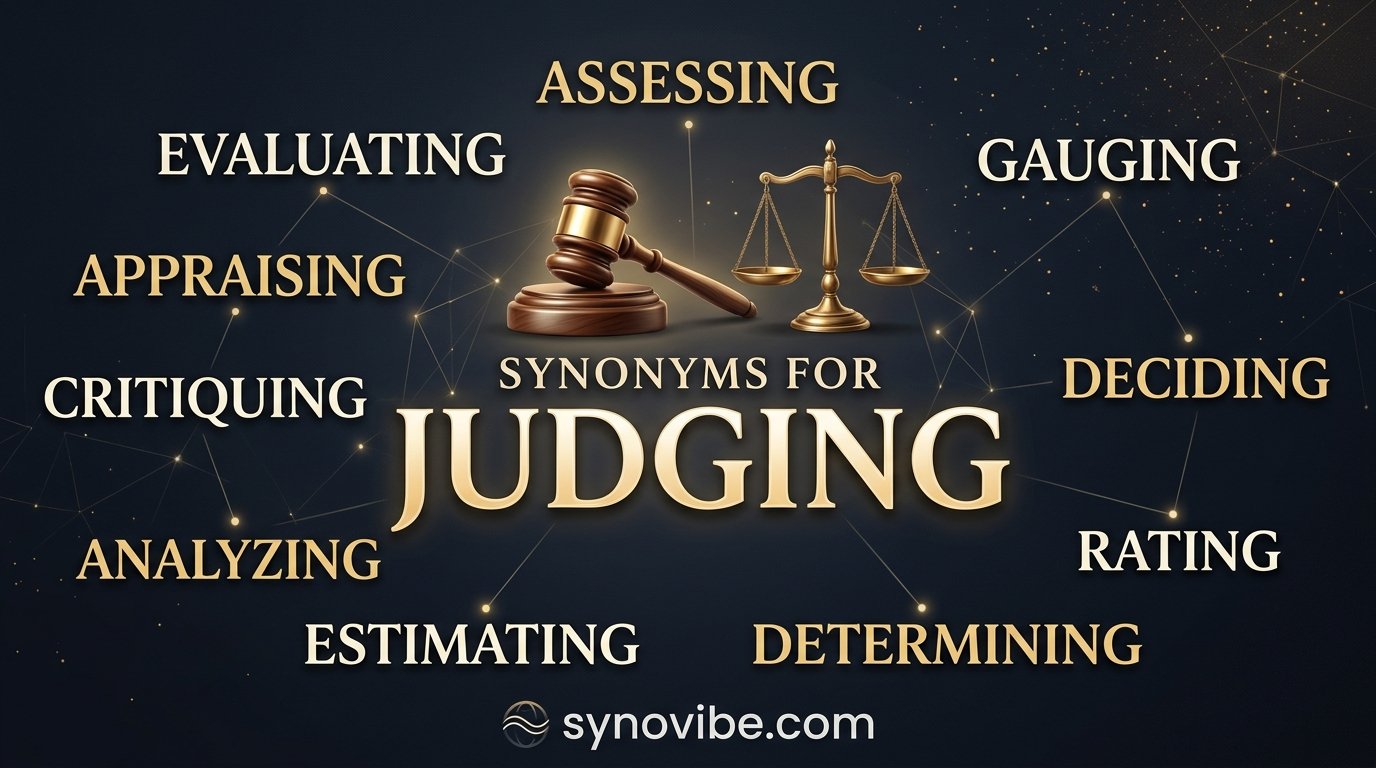
The best synonyms for judging include evaluating, assessing, appraising, examining, reviewing, analyzing, criticizing, determining, deciding, and rating.
The most appropriate synonym depends on what judging means in your sentence.
- Evaluating: Forming an opinion about quality or value.
- Assessing: Measuring or considering a situation, ability, or condition.
- Appraising: Estimating the value or quality of something.
- Examining: Looking at something carefully to understand it.
- Criticizing: Pointing out faults or weaknesses.
- Determining: Establishing a fact or reaching a conclusion.
- Rating: Giving something a score or level.
Example: Instead of saying, “The teacher is judging the students’ work,” you could say, “The teacher is evaluating the students’ work.”
Evaluating is particularly suitable when the teacher is considering the quality of assignments against specific standards.
Meaning and Usage of Judging
What Does Judging Mean?
Judging means forming an opinion, making an assessment, or reaching a decision about someone or something. It can involve considering evidence, comparing qualities, identifying strengths and weaknesses, or deciding whether something meets particular standards.
The word comes from the verb judge and can be used in several situations.
1. Evaluating quality
Judging can mean deciding how good, effective, or valuable something is.
Example: The panel is judging the quality of the performances.
2. Forming an opinion about a person
Judging can mean forming an opinion about someone’s character, behavior, or decisions.
Example: We should avoid judging people without understanding their circumstances.
3. Making an official decision
Judging can refer to deciding a dispute, evaluating a competition, or determining whether someone has followed established rules.
Example: The referee is judging whether the player committed a foul.
4. Reaching a conclusion
Judging can involve using available information to make a decision or form an opinion.
Example: Judging by the dark clouds, it may rain soon.
Different Forms of Judging
Understanding the grammatical forms of the word helps you use its synonyms correctly.
| Word Form | Meaning | Example |
| Judge | Base verb or noun | We should not judge others unfairly. |
| Judging | Present participle or gerund | She is judging the competition. |
| Judged | Past tense or past participle | The entries were judged fairly. |
| Judgment | The act of forming an opinion or making a decision | His judgment was based on evidence. |
| Judgmental | Tending to criticize or form negative opinions about others | He sounded judgmental during the discussion. |
Notice that judgmental usually describes a tendency to judge people critically, often unfairly. It is not a direct synonym for the action of evaluating something.
30 Synonyms for Judging With Meanings and Examples
The following words can replace judging in particular contexts. Some are close synonyms, while others express a related action or a more specific type of judgment.
1. Evaluating
Simple meaning: Examining something to determine its quality, effectiveness, or value.
Example: The teacher is evaluating the students’ final projects.
Best usage/context: Academic assessments, performance reviews, business decisions, and quality checks.
Evaluating is one of the most versatile synonyms for judging when the purpose is to determine how well something meets particular standards.
2. Assessing
Simple meaning: Carefully considering a situation, ability, condition, or level of performance.
Example: The doctor is assessing the patient’s condition.
Best usage/context: Education, healthcare, business, risk management, and professional evaluations.
Assessing often emphasizes understanding a current condition or measuring performance rather than expressing a personal opinion.
3. Appraising
Simple meaning: Estimating the value, quality, or importance of something.
Example: The expert is appraising the antique painting.
Best usage/context: Property valuation, art, jewelry, employee performance, and formal evaluations.
Use appraising when determining worth or value is central to the judgment.
4. Examining
Simple meaning: Looking at something carefully to understand it or identify important details.
Example: The researcher is examining the evidence before reaching a conclusion.
Best usage/context: Scientific research, investigations, academic work, and detailed inspections.
Examining focuses on careful observation. It does not necessarily mean that a final judgment has already been made.
5. Analyzing
Simple meaning: Studying something in detail to understand its parts, causes, or meaning.
Example: The team is analyzing the results before making a decision.
Best usage/context: Research, problem-solving, data interpretation, and critical thinking.
Choose analyzing when judging involves breaking information into parts and understanding how those parts relate to one another.
6. Reviewing
Simple meaning: Looking over something to assess its quality, accuracy, or suitability.
Example: The editor is reviewing the article before publication.
Best usage/context: Editing, academic work, business documents, performance reports, and product assessments.
Reviewing is particularly useful when someone examines existing work before approving, revising, or evaluating it.
7. Criticizing
Simple meaning: Expressing disapproval or identifying faults and weaknesses.
Example: The reviewer is criticizing the film’s weak storyline.
Best usage/context: Reviews, discussions of performance, feedback, and situations involving shortcomings.
Unlike evaluating, criticizing often emphasizes problems or negative observations. It does not always mean judging unfairly.
8. Assessing the merits
Simple meaning: Considering the strengths, advantages, and value of something.
Example: The committee is assessing the merits of each proposal.
Best usage/context: Formal discussions, business decisions, policy reviews, and academic arguments.
This phrase is useful when the judgment focuses on whether an idea or proposal deserves support.
9. Determining
Simple meaning: Establishing a fact or reaching a conclusion after consideration.
Example: The investigator is determining the cause of the accident.
Best usage/context: Investigations, official decisions, problem-solving, and fact-finding.
Determining emphasizes reaching an answer rather than the entire process of examining evidence.
10. Deciding
Simple meaning: Choosing an option or reaching a conclusion.
Example: The judges are deciding which team deserves first place.
Best usage/context: Competitions, personal choices, workplace decisions, and everyday conversations.
Use deciding when the judgment leads directly to a choice.
11. Rating
Simple meaning: Giving something a score, grade, or level according to certain criteria.
Example: Customers are rating the service after their visits.
Best usage/context: Surveys, reviews, competitions, customer feedback, and performance measurement.
Rating is appropriate when a judgment is expressed through a score, ranking level, or numerical value.
12. Scoring
Simple meaning: Assigning points based on performance or established rules.
Example: The judges are scoring each presentation according to its clarity and accuracy.
Best usage/context: Sports, examinations, competitions, and performance-based assessments.
Unlike general judging, scoring specifically emphasizes assigning points.
13. Ranking
Simple meaning: Arranging people or things in order according to quality, performance, or importance.
Example: The committee is ranking the applicants according to their qualifications.
Best usage/context: Competitions, hiring, academic comparisons, and product comparisons.
Use ranking when judging involves comparing multiple options and placing them in a particular order.
14. Inspecting
Simple meaning: Checking something carefully to identify problems or confirm that it meets requirements.
Example: The engineer is inspecting the building for structural damage.
Best usage/context: Safety checks, quality control, equipment maintenance, and formal inspections.
Inspecting is more focused on checking conditions than expressing an overall opinion.
15. Scrutinizing
Simple meaning: Examining something very carefully and critically.
Example: The auditor is scrutinizing the financial records for errors.
Best usage/context: Investigations, audits, detailed reviews, and situations requiring close attention.
This word suggests a particularly thorough examination, often because accuracy or potential problems are important.
16. Weighing
Simple meaning: Carefully considering different factors, arguments, or possibilities before making a decision.
Example: The committee is weighing the advantages and disadvantages of the proposal.
Best usage/context: Decision-making, ethical discussions, negotiations, and comparisons.
Weighing emphasizes considering different sides rather than immediately reaching a conclusion.
17. Considering
Simple meaning: Thinking carefully about something before forming an opinion or making a decision.
Example: The manager is considering each applicant’s experience.
Best usage/context: Everyday conversations, planning, professional decisions, and thoughtful discussions.
Considering is a broad, neutral alternative when someone is taking relevant information into account.
18. Deliberating
Simple meaning: Discussing or thinking carefully about something before deciding.
Example: The jury is deliberating before announcing its verdict.
Best usage/context: Legal proceedings, committee meetings, formal decisions, and serious discussions.
This word emphasizes a careful decision-making process that may involve several people.
19. Adjudicating
Simple meaning: Making an official decision about a dispute or competition.
Example: The official is adjudicating the dispute between the two competitors.
Best usage/context: Courts, formal disputes, competitions, and regulatory proceedings.
Adjudicating is more formal than judging and usually involves an authorized person or body.
20. Discerning
Simple meaning: Recognizing or understanding important differences, qualities, or details.
Example: The editor is discerning which arguments are supported by strong evidence.
Best usage/context: Critical thinking, literary analysis, professional assessments, and situations requiring good judgment.
Discerning emphasizes the ability to recognize meaningful differences rather than simply expressing an opinion.
21. Interpreting
Simple meaning: Explaining or understanding the meaning of information, actions, or events.
Example: The researcher is interpreting the survey results.
Best usage/context: Literature, research, communication, data analysis, and discussions of behavior.
Interpreting can contribute to judging, but it focuses on understanding meaning rather than necessarily deciding whether something is good or bad.
22. Classifying
Simple meaning: Organizing people or things into categories based on shared characteristics.
Example: The scientist is classifying the samples according to their properties.
Best usage/context: Science, education, research, information management, and categorization.
Use classifying when the judgment involves deciding which group or category something belongs to.
23. Verifying
Simple meaning: Checking whether information is accurate or true.
Example: The editor is verifying the facts before publishing the report.
Best usage/context: Fact-checking, research, journalism, administration, and quality assurance.
Verifying is appropriate when judgment depends on confirming facts, although it does not cover every kind of evaluation.
24. Validating
Simple meaning: Confirming that something is acceptable, sound, or supported by appropriate evidence or criteria.
Example: The researchers are validating the results with additional tests.
Best usage/context: Research, testing, data quality, business processes, and technical assessments.
Validating emphasizes establishing that something meets particular requirements or has adequate support.
25. Estimating
Simple meaning: Making an approximate calculation or assessment.
Example: The contractor is estimating the cost of repairing the roof.
Best usage/context: Budgeting, planning, construction, forecasting, and preliminary assessments.
Estimating is a useful alternative when the judgment concerns an approximate amount, value, or likelihood.
26. Diagnosing
Simple meaning: Identifying the cause or nature of a problem or condition.
Example: The technician is diagnosing the problem with the computer.
Best usage/context: Healthcare, troubleshooting, technical support, and problem-solving.
Diagnosing is more specific than judging because it focuses on identifying the underlying cause of a problem.
27. Condemning
Simple meaning: Expressing strong disapproval of an action, behavior, or decision.
Example: The organization is condemning the unfair treatment of workers.
Best usage/context: Ethical discussions, public statements, social issues, and serious criticism.
Unlike neutral evaluation, condemning communicates a strongly negative judgment.
28. Finding fault
Simple meaning: Identifying mistakes, weaknesses, or shortcomings.
Example: The supervisor is finding fault with the report’s unclear explanations.
Best usage/context: Critical feedback, editing, disagreements, and discussions of mistakes.
This phrase often suggests a negative focus, particularly when someone repeatedly emphasizes what is wrong.
29. Forming an opinion
Simple meaning: Developing a personal view about someone or something.
Example: She is forming an opinion after listening to both sides of the argument.
Best usage/context: Everyday conversations, personal relationships, discussions, and decision-making.
This phrase is especially useful when judging means developing a belief or viewpoint rather than making an official decision.
30. Passing judgment
Simple meaning: Expressing a conclusion or opinion about someone or something, often before fully understanding the situation.
Example: It is unfair to pass judgment before hearing everyone’s explanation.
Best usage/context: Personal relationships, moral discussions, social situations, and conversations about fairness.
Although closely related to judging, this phrase often carries a stronger implication of criticism or a potentially premature opinion.
Comparison Table: Which Judging Synonym Should You Use?
The best word depends on what you are evaluating, how you are evaluating it, and whether your judgment is neutral, positive, or negative.
| Synonym | Main Meaning | Tone | Best Context |
| Evaluating | Determining quality or effectiveness | Neutral | Academic and professional assessments |
| Assessing | Examining a condition or ability | Neutral | Performance and risk assessments |
| Appraising | Estimating worth or value | Formal | Property and asset valuation |
| Examining | Looking closely at details | Neutral | Research and investigations |
| Analyzing | Studying parts and relationships | Analytical | Research and problem-solving |
| Reviewing | Looking over existing work | Neutral | Editing and quality checks |
| Criticizing | Identifying faults or expressing disapproval | Often negative | Feedback and reviews |
| Determining | Reaching a conclusion | Neutral | Investigations and fact-finding |
| Deciding | Choosing an option | Neutral | Everyday and professional choices |
| Rating | Assigning a score or level | Neutral | Surveys and reviews |
| Scoring | Assigning points | Neutral | Exams and competitions |
| Ranking | Ordering options by relative standing | Neutral | Comparisons and competitions |
| Inspecting | Checking condition or compliance | Neutral | Safety and quality control |
| Scrutinizing | Examining very carefully | Critical | Audits and detailed investigations |
| Weighing | Considering different factors | Thoughtful | Complex decisions |
| Considering | Thinking about relevant information | Neutral | Everyday decisions |
| Deliberating | Thinking carefully before deciding | Formal | Jury and committee decisions |
| Adjudicating | Making an official ruling | Formal | Disputes and competitions |
| Discerning | Recognizing meaningful differences | Thoughtful | Critical analysis |
| Interpreting | Understanding meaning | Neutral | Literature and data analysis |
| Classifying | Assigning categories | Neutral | Research and organization |
| Verifying | Checking accuracy | Neutral | Fact-checking |
| Validating | Confirming acceptability or soundness | Formal | Testing and research |
| Estimating | Calculating approximately | Neutral | Budgeting and planning |
| Diagnosing | Identifying a problem’s cause | Technical | Healthcare and troubleshooting |
| Condemning | Expressing strong disapproval | Strongly negative | Ethical and social issues |
| Finding fault | Identifying shortcomings | Often negative | Critical feedback |
| Forming an opinion | Developing a personal view | Neutral | Personal and social situations |
| Passing judgment | Expressing a conclusion about someone or something | Often critical | Discussions about fairness |
| Assessing the merits | Considering strengths and value | Formal | Proposals and arguments |
Quick Comparison: Evaluating vs. Assessing vs. Judging
These three words are similar, but their emphasis differs.
- Judging: Forming an opinion or reaching a conclusion.
- Evaluating: Determining quality or effectiveness against relevant criteria.
- Assessing: Examining a condition, ability, risk, or situation.
Consider these examples:
- The teacher is judging the competition.
- The teacher is evaluating the quality of each presentation.
- The teacher is assessing each student’s understanding of the subject.
All three sentences are correct, but each emphasizes a slightly different aspect of the process.
How to Choose the Right Synonym for Judging
Choosing the right synonym requires considering your tone, intended meaning, and purpose.
1. Choose According to Tone
Your word choice can make a sentence sound neutral, formal, analytical, or critical.
For a neutral tone
Use evaluating, assessing, considering, or reviewing.
Example: The manager is evaluating the team’s performance.
These words work well when you want to describe an assessment without suggesting unfairness or hostility.
For a formal tone
Use appraising, deliberating, adjudicating, or assessing the merits.
Example: The committee is deliberating on the proposed changes.
These expressions are suitable for professional reports, official proceedings, and academic writing.
For a critical tone
Use criticizing, scrutinizing, finding fault, or condemning.
Example: The reviewer is criticizing the article’s unsupported claims.
These words emphasize weaknesses, close examination, or disapproval.
For a thoughtful tone
Use weighing, discerning, or considering.
Example: She is weighing the consequences before making a decision.
These expressions highlight careful thought rather than an immediate reaction.
2. Choose According to Meaning
Different situations require different kinds of judgment.
When judging quality
Choose evaluating, assessing, or appraising.
Example: The company is evaluating the effectiveness of its new training program.
When judging accuracy
Choose verifying, examining, or scrutinizing.
Example: The journalist is verifying the information before releasing the story.
When judging performance
Choose rating, scoring, or ranking.
Example: The panel is ranking the candidates according to their interview performance.
When judging a person’s behavior
Choose evaluating, criticizing, or forming an opinion, depending on the intended meaning.
Example: We should consider the circumstances before forming an opinion about his decision.
When judging a dispute
Choose adjudicating, deliberating, or determining.
Example: The panel is adjudicating the dispute according to the established rules.
3. Choose According to Intent
Think about what the person is trying to accomplish.
To understand something: Use examining, analyzing, or interpreting.
Example: The students are analyzing the author’s argument.
To make a decision: Use deciding, determining, or deliberating.
Example: The committee is deciding which proposal to approve.
To measure performance: Use assessing, evaluating, or rating.
Example: The coach is assessing the players’ progress.
To identify a problem: Use diagnosing, inspecting, or verifying.
Example: The technician is diagnosing the cause of the system failure.
To express disapproval: Use criticizing or condemning.
Example: The organization is condemning the use of dishonest practices.
To express a personal opinion: Use forming an opinion or passing judgment.
Example: Avoid passing judgment on someone based on a single mistake.
4. Consider Your Audience
The best synonym also depends on who will read or hear your words.
For students and general readers, simple words such as examining, deciding, and considering are often clear and effective.
For academic writing, evaluating, analyzing, and assessing may communicate the intended process more precisely.
For business communication, reviewing, appraising, and determining can be appropriate when used in the right context.
For creative writing, criticizing, discerning, and passing judgment can express stronger emotions or more specific attitudes.
Always choose clarity over complexity. A familiar word that accurately expresses your meaning is usually better than an elaborate word that makes your sentence difficult to understand.
Common Mistakes When Using Judging Synonyms
Although many words are related to judging, they cannot all replace one another in every sentence.
Mistake 1: Treating Every Synonym as an Exact Replacement
Incorrect usage often occurs when writers assume that every related word has the same meaning.
For example:
Incorrect: The referee is analyzing the winner of the race.
Better: The referee is determining the winner of the race.
Why? Analyzing means studying something in detail, whereas determining means establishing an answer or conclusion. Depending on the situation, deciding may also be appropriate.
Mistake 2: Confusing Judging With Criticizing
Judging does not always mean expressing disapproval.
Incorrect: The teacher is criticizing every student’s work fairly.
Better: The teacher is evaluating every student’s work fairly.
Why? Evaluating describes a neutral assessment. Criticizing usually emphasizes faults or negative feedback, even when the criticism is justified.
Mistake 3: Using Appraising for Every Type of Assessment
Appraising is especially useful when estimating value or worth, but it is not the most natural choice in every situation.
Less natural: The doctor is appraising the patient’s temperature.
Better: The doctor is assessing the patient’s condition.
Why? Assessing is more suitable for examining a medical condition, while appraising often refers to determining the value or quality of something.
Mistake 4: Confusing Rating With Ranking
These words describe different activities.
- Rating: Giving each item a score or level.
- Ranking: Placing items in order relative to one another.
Example of rating: The customers rated each restaurant from one to five stars.
Example of ranking: The guide ranked the restaurants from best to worst according to its criteria.
A rating does not automatically establish a ranking unless the scores are compared.
Mistake 5: Using Judgmental When You Mean Judging
Judging refers to forming an opinion or making an assessment. Judgmental describes someone who tends to criticize others or form opinions about them, often unfairly.
Incorrect: The committee is judgmental the applications.
Better: The committee is judging the applications.
Another correct sentence: The committee’s comments sounded judgmental.
Remember that judgmental is an adjective, not a verb.
Mistake 6: Confusing Examining With Concluding
Examining something does not necessarily mean reaching a final decision.
Example: The investigator is examining the evidence.
This sentence tells us that the investigator is studying the evidence. It does not establish whether the investigator has reached a conclusion.
If a conclusion has been reached, determining or deciding may be more appropriate.
Mistake 7: Ignoring the Difference Between Judging People and Judging Work
The context can change which synonym sounds natural.
Example: The manager is evaluating the employee’s performance.
This sounds professional because the manager is assessing work-related results.
Example: The manager is criticizing the employee’s personality.
This expresses a more negative attitude toward the person rather than an assessment of job performance.
Whenever possible, describe the specific behavior, action, or performance you are evaluating instead of making broad assumptions about someone’s character.
FAQs:
1. What Is the Best Synonym for Judging?
The best general synonym for judging is evaluating when the context involves assessing quality, performance, or value. Other suitable choices include assessing, examining, appraising, and determining.
The right word depends on whether you are forming an opinion, examining evidence, measuring performance, or making a decision.
2. What Is Another Word for Judging Someone?
Depending on your intended meaning, you can use evaluating, assessing, forming an opinion about, or passing judgment on someone.
For example, “She is evaluating the candidate’s qualifications” sounds neutral and professional.
However, “She is passing judgment on the candidate” may suggest that she is expressing a personal or potentially critical opinion.
3. What Is a Positive Synonym for Judging?
Words such as appreciating, recognizing, discerning, and evaluating may be appropriate when the judgment involves recognizing strengths or positive qualities.
For example: “The teacher is recognizing the students’ creative abilities.”
However, these words are not interchangeable in every context. Appreciating emphasizes recognizing value, while evaluating can lead to either a positive or negative conclusion.
4. What Is a Negative Synonym for Judging?
Common negative alternatives include criticizing, condemning, finding fault, and passing judgment.
For example: “The reviewer is criticizing the company’s poor customer service.”
These expressions are suitable when the intended meaning involves identifying weaknesses, expressing disapproval, or making a negative assessment.
5. What Is the Difference Between Judging and Evaluating?
Judging is a broad term for forming an opinion or reaching a conclusion. Evaluating specifically emphasizes assessing quality, value, or effectiveness.
For example, a person may judge whether an action was fair, while a manager may evaluate whether a project met its goals.
The words overlap, but evaluating often sounds more systematic and criteria-based.
6. Is Assessing a Synonym for Judging?
Yes. Assessing is a close synonym when judging involves examining a condition, ability, risk, or level of performance.
For example: “The coach is assessing the players’ fitness.”
However, assessing does not always imply a final decision. It may simply involve gathering information to understand a situation.
7. What Is the Difference Between Judging and Being Judgmental?
Judging means forming an opinion or making an assessment. Being judgmental means tending to criticize others or form opinions about them, often without sufficient understanding or consideration.
For example, a teacher can judge an assignment according to clear standards without being judgmental toward the student.
The distinction is important because fair evaluation does not automatically involve unfair personal criticism.
8. How Can I Avoid Repeating the Word Judging in My Writing?
Choose a synonym that expresses the precise action taking place.
Use evaluating for quality, assessing for conditions or performance, analyzing for detailed study, determining for reaching a conclusion, and criticizing for identifying faults.
For example, instead of repeatedly writing, “The committee is judging the proposals,” you could write, “The committee is reviewing the proposals, assessing their strengths, and determining which option best meets the requirements.”
This approach improves clarity and creates more natural, varied writing without forcing unnecessary synonyms into your sentences.
Conclusion
Choosing the right judging synonym helps you communicate your ideas with greater accuracy, variety, and confidence. Although evaluating, assessing, examining, appraising, and determining share aspects of the meaning of judging, each word emphasizes a different action.
Use evaluating when discussing quality, assessing when examining a condition or ability, analyzing when studying information in detail, and determining when reaching a conclusion. Choose criticizing or condemning when you specifically mean expressing disapproval.
Remember that context matters more than simply replacing one word with another. Consider your intended meaning, the tone of your sentence, and your audience before selecting a synonym.
By understanding these 30 alternatives and their differences, you can improve your vocabulary, write more naturally, and express judgments more precisely in academic assignments, professional documents, and everyday conversations.

Henry Walker is a content writer who enjoys exploring vocabulary, word meanings, and the subtle differences between expressions. He creates clear, practical content to help readers discover useful synonyms and choose the most appropriate words for everyday writing and communication.