Inflation is a common economic term that describes rising prices and decreasing purchasing power. However, depending on the context, you may need a different word to explain increasing costs, expensive goods, or changes in the value of money. Understanding an inflation synonym helps students, ESL learners, writers, and content creators communicate more clearly and accurately.
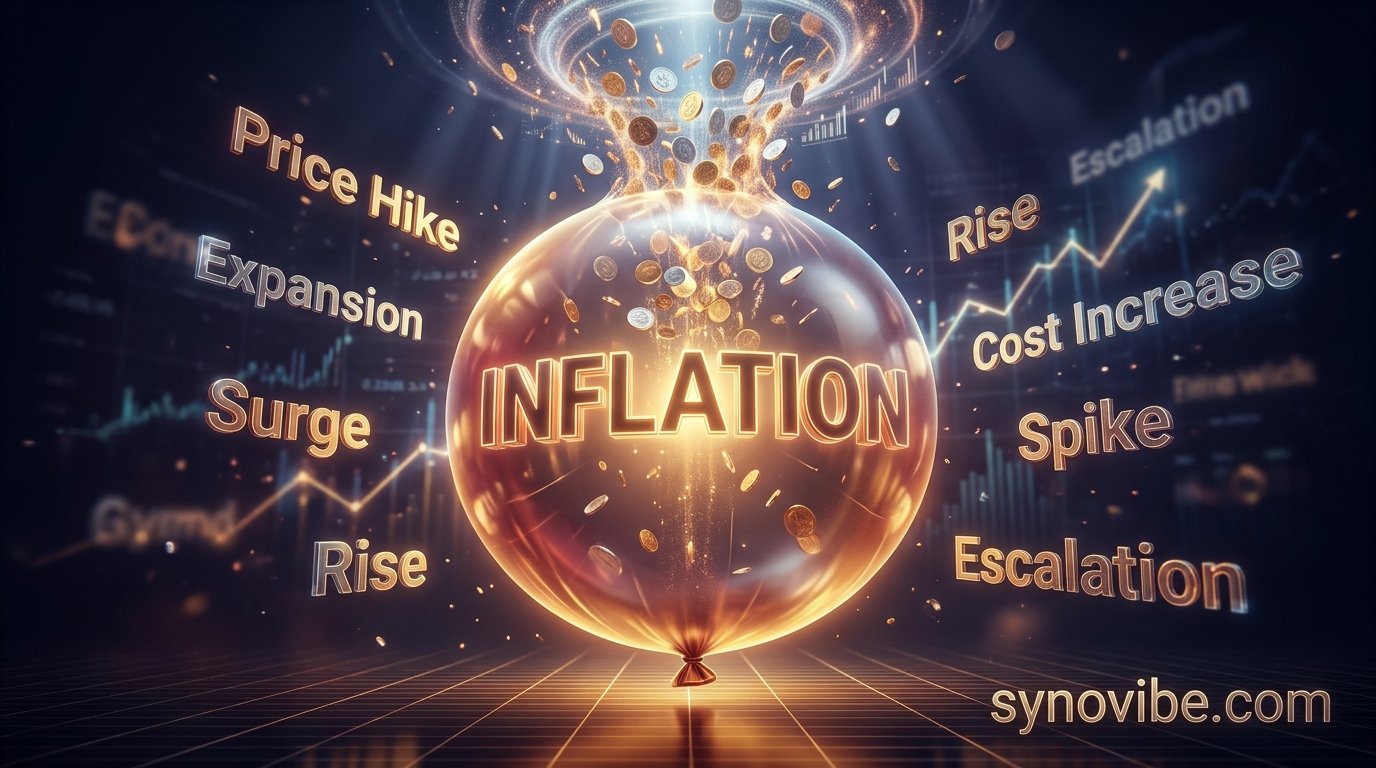
Some useful alternatives include price rise, price increase, escalation, surge, upswing, and cost increase. Related terms such as devaluation and monetary expansion describe different economic processes, so they should not always replace inflation directly.
This guide explains 30 inflation synonyms and related expressions, with simple meanings, realistic example sentences, and advice on when to use each word.
Quick Answer: What Is a Synonym for Inflation?
The best synonym for inflation is price rise or price increase when you mean that the general cost of goods and services is going up.
Other useful alternatives include:
- Price hike: A noticeable increase in prices.
- Cost escalation: A gradual or significant increase in costs.
- Price surge: A sudden and substantial rise in prices.
- Rising prices: A simple, everyday expression for increasing costs.
- Cost increase: A general phrase for higher expenses.
- Upswing: An increase or upward movement in a trend.
The most accurate word depends on your sentence. In economics, inflation specifically refers to a sustained increase in the general price level across an economy, rather than an increase in the price of just one product.
Meaning and Usage of Inflation
What Does Inflation Mean?
Inflation is the process in which the general prices of goods and services rise over time, reducing the amount of goods and services that a unit of money can buy.
For example, suppose a basket of groceries costs $50 one year and $55 the following year. If the increase reflects a broader rise in prices, it may be part of inflation.
Inflation affects everyday expenses, including food, housing, transportation, education, healthcare, and energy.
How Is Inflation Used in a Sentence?
Inflation is commonly used in economics, business reports, financial discussions, news articles, and everyday conversations.
Examples:
- Inflation has increased the cost of groceries this year.
- High inflation makes it harder for families to manage their budgets.
- The government introduced measures to control inflation.
- Workers requested higher salaries to keep up with rising prices.
Is Inflation the Same as Rising Prices?
Not exactly.
Inflation describes an increase in the general price level across an economy. Rising prices can refer to either broad inflation or the increasing price of a specific product.
For example, if the price of coffee increases because of a poor harvest, that change alone does not necessarily mean the economy is experiencing higher inflation.
Similarly, a price surge can describe a sudden increase in one product’s price, while inflation generally refers to a broader economic trend.
30 Inflation Synonyms and Related Words
The following list includes direct alternatives, descriptive expressions, and related economic terms. Some work well as replacements for inflation, while others describe specific aspects or possible causes of rising prices.
1. Price Rise
Meaning: An increase in the price of goods or services.
Example: The recent price rise has made household shopping more expensive.
Best usage/context: Use this straightforward expression in everyday conversations, school assignments, and general writing.
2. Price Increase
Meaning: A higher price than before.
Example: The price increase affected customers who regularly purchased imported products.
Best usage/context: Suitable for formal writing, business communication, and economic explanations. It can describe one item or a wider increase in prices.
3. Price Hike
Meaning: A noticeable or significant increase in a price.
Example: The company announced a price hike for its monthly subscription.
Best usage/context: Best for news articles, consumer discussions, and situations involving an unpopular or substantial price change.
4. Rising Prices
Meaning: Prices that continue to move upward.
Example: Rising prices have forced many families to reconsider their monthly budgets.
Best usage/context: Ideal for simple English, news reporting, and explanations of how inflation affects ordinary people.
5. Cost Increase
Meaning: A rise in the amount of money needed to buy something or provide a service.
Example: The cost increase made the construction project more expensive than expected.
Best usage/context: Useful in business, budgeting, project management, and discussions of household expenses.
6. Cost Escalation
Meaning: A substantial or continuing increase in costs over time.
Example: Cost escalation delayed the completion of the highway project.
Best usage/context: Best for professional reports, construction projects, manufacturing, and financial planning. It does not necessarily mean economy-wide inflation.
7. Price Escalation
Meaning: A progressive or significant increase in prices.
Example: Price escalation in the housing market made homeownership more difficult.
Best usage/context: Suitable for formal reports and discussions of markets where prices rise significantly over time.
8. Price Surge
Meaning: A sudden and substantial increase in prices.
Example: A price surge in natural gas increased heating expenses during winter.
Best usage/context: Use it when prices rise quickly over a relatively short period. It can describe an individual product or a wider market.
9. Price Spike
Meaning: A sharp, often sudden increase in price.
Example: A temporary price spike occurred after severe weather disrupted food deliveries.
Best usage/context: Best for temporary increases, market disruptions, and news about sudden changes in commodity prices.
10. Price Inflation
Meaning: An increase in prices, often used to emphasize the price-level aspect of inflation.
Example: Price inflation reduced the purchasing power of the family’s monthly income.
Best usage/context: Useful in economic explanations when distinguishing price changes from other forms of inflation, such as wage inflation. It is generally a descriptive phrase rather than a distinct synonym.
11. Cost Inflation
Meaning: An increase in costs, particularly the costs businesses face when producing goods or delivering services.
Example: Cost inflation forced the manufacturer to review its pricing strategy.
Best usage/context: Suitable for business and financial writing. It may refer to rising input costs rather than inflation across the whole economy.
12. Escalation
Meaning: A process in which something increases or becomes more intense.
Example: The escalation of food prices placed additional pressure on low-income households.
Best usage/context: Use it in formal writing when the context clearly identifies what is increasing. On its own, escalation does not necessarily mean inflation.
13. Increase
Meaning: A general rise in amount, number, level, or value.
Example: An increase in transportation costs affected the company’s annual budget.
Best usage/context: A simple and flexible word for students, beginners, and general-purpose writing. Specify what is increasing to avoid ambiguity.
14. Upswing
Meaning: An upward movement or increase in a trend.
Example: The market experienced an upswing in prices after supply became limited.
Best usage/context: Useful in business journalism and economic commentary. It describes an upward trend, not necessarily sustained economy-wide inflation.
15. Upward Trend
Meaning: A pattern in which a value continues to move higher over time.
Example: The report showed an upward trend in food prices over several months.
Best usage/context: Appropriate for reports, data analysis, essays, and explanations of changing prices.
16. Rise in the Cost of Living
Meaning: An increase in the total expenses needed to maintain a particular standard of living.
Example: The rise in the cost of living has made rent, food, and transportation harder to afford.
Best usage/context: Best when discussing the practical effects of inflation on households. The cost of living can also change because of local housing costs or other factors.
17. Cost-of-Living Increase
Meaning: An increase in everyday living expenses.
Example: Employees requested a salary adjustment after a significant cost-of-living increase.
Best usage/context: Useful in salary negotiations, household budgeting, public policy, and discussions of workers’ purchasing power.
18. Dearness
Meaning: The condition of being expensive or costing a great deal.
Example: The dearness of essential goods became a major concern for local residents.
Best usage/context: More common in certain varieties of English, including South Asian usage. In many other contexts, high prices or expensiveness sounds more natural.
19. Expensiveness
Meaning: The quality of costing a lot of money.
Example: The expensiveness of city housing encouraged some families to move to smaller towns.
Best usage/context: Useful when discussing the general cost of something. It is not a direct synonym for inflation because it describes a condition rather than a process of rising prices.
20. High Prices
Meaning: Prices that are expensive compared with a relevant standard or expectation.
Example: High prices have reduced demand for some household appliances.
Best usage/context: Best for everyday speech, beginner-level English, and clear explanations for general readers.
21. Price Pressure
Meaning: Conditions or forces that push prices upward.
Example: Higher fuel and shipping costs created price pressure across several industries.
Best usage/context: Suitable for economic reports and business discussions. Price pressure can contribute to inflation without necessarily resulting in a sustained general price increase.
22. Inflationary Pressure
Meaning: Economic forces that may cause the general price level to rise.
Example: Strong consumer demand created inflationary pressure in the service sector.
Best usage/context: Best for economics essays, financial news, central bank discussions, and policy analysis.
23. Overpricing
Meaning: Setting a price higher than is considered reasonable, justified, or competitive.
Example: Customers complained about the overpricing of basic supplies at the resort.
Best usage/context: Use this term when suggesting that prices are unfairly high. Overpricing is not the same as inflation, which can occur without sellers charging unreasonable prices.
24. Markup
Meaning: The amount added to the cost of a product to determine its selling price.
Example: The retailer reduced its markup to remain competitive in the local market.
Best usage/context: Useful in retail, accounting, business studies, and pricing strategies. A markup is a pricing method, not a synonym for inflation.
25. Depreciation of Money
Meaning: A decrease in the value or purchasing power of money.
Example: The depreciation of money reduced the amount of imported goods the company could afford.
Best usage/context: Use it when discussing declining monetary value. It is related to inflation because inflation reduces domestic purchasing power, but currency depreciation against other currencies is a separate concept.
26. Devaluation
Meaning: An official reduction in a currency’s value under a fixed or managed exchange-rate system.
Example: The devaluation of the currency made imported machinery more expensive.
Best usage/context: Best for international economics, exchange rates, and monetary policy. Devaluation can contribute to inflation through higher import prices, but the terms are not interchangeable.
27. Monetary Expansion
Meaning: An increase in the supply of money in an economy.
Example: The economist examined whether monetary expansion contributed to rising consumer prices.
Best usage/context: Appropriate for economics textbooks and discussions of monetary policy. Monetary expansion may contribute to inflation under certain conditions, but it does not automatically produce it.
28. Demand-Pull Inflation
Meaning: Inflation that occurs when overall demand for goods and services grows faster than the economy’s ability to supply them.
Example: Strong consumer spending contributed to demand-pull inflation in the growing economy.
Best usage/context: Use this specific term when explaining one possible cause of inflation in economics lessons or research.
29. Cost-Push Inflation
Meaning: Inflation caused by rising production costs that businesses pass on to consumers.
Example: Higher energy and raw-material costs contributed to cost-push inflation.
Best usage/context: Best for explaining how more expensive labor, fuel, materials, or transportation can increase prices across an economy.
30. Hyperinflation
Meaning: An extremely rapid and severe increase in the general price level.
Example: Hyperinflation made it difficult for residents to rely on their currency for everyday purchases.
Best usage/context: Use this precise economic term only for exceptionally severe inflation. It is not an appropriate replacement for ordinary inflation.
Comparison Table: Which Inflation Synonym Should You Use?
The best alternative depends on the specific meaning you want to communicate.
| Word or phrase | Main meaning | Best context |
| Price rise | Prices become higher | Everyday English |
| Price increase | A price goes up | Formal and general writing |
| Price hike | A noticeable price increase | News and consumer discussions |
| Rising prices | Prices move upward | Simple explanations |
| Cost escalation | Costs increase significantly | Business and projects |
| Price surge | A sudden, large increase | Markets and news |
| Price spike | A sharp, often temporary rise | Short-term price changes |
| Upswing | An upward movement | Trends and market commentary |
| Cost of living | Expenses of everyday life | Household finances |
| Inflationary pressure | Forces pushing prices upward | Economic analysis |
| Overpricing | Prices considered unjustifiably high | Consumer complaints |
| Devaluation | An official currency-value reduction | Exchange-rate policy |
| Monetary expansion | Money supply grows | Monetary economics |
| Cost-push inflation | Rising production costs drive inflation | Economics education |
| Hyperinflation | Extremely rapid inflation | Severe economic crises |
Remember that a word may be related to inflation without being a true synonym. When writing an academic paper, choose the term that accurately represents the economic process being discussed.
How to Choose the Right Inflation Synonym
You can select the right word by considering tone, meaning, and intent.
1. Choose According to Tone
For everyday conversations
Use simple and familiar expressions:
- Rising prices
- Price increase
- High prices
- Cost increase
Example: Rising prices are making groceries more expensive.
For formal and academic writing
Choose precise expressions that suit the subject:
- Price-level increase
- Inflationary pressure
- Cost escalation
- Price escalation
Example: Inflationary pressure remained elevated as production costs increased.
For news articles
Use direct language that conveys the scale or speed of a change:
- Price hike
- Price surge
- Price spike
- Rising costs
Example: A sudden price spike increased transportation expenses.
For business writing
Use terms that explain financial changes:
- Cost escalation
- Cost inflation
- Price increase
- Upward trend
Example: Cost escalation affected the project’s final budget.
2. Choose According to Meaning
Different words communicate different types of increases.
- General price increases: Use inflation, rising prices, or price-level increase.
- A sudden increase: Use price surge or price spike.
- Higher business expenses: Use cost increase or cost escalation.
- Expensive everyday living: Use rise in the cost of living.
- Forces that may increase prices: Use inflationary pressure.
- A declining currency value: Use currency depreciation or devaluation, depending on the economic situation.
- Extremely rapid inflation: Use hyperinflation only when the severity warrants it.
3. Choose According to Intent
Ask yourself what you want readers to understand.
If you are explaining why groceries cost more, rising food prices may be the clearest choice.
If you are describing a broad economic trend, inflation is usually more accurate.
If you are reporting a sudden jump in fuel prices, price surge may communicate the change more effectively.
If you are explaining why a business is spending more on raw materials, cost escalation may be more suitable.
If you are discussing the relationship between the money supply and prices, monetary expansion may be relevant, but it should not be used as a substitute for inflation itself.
Common Mistakes When Using Inflation Synonyms
Even closely related words can have different meanings. Avoid these common errors to make your writing more accurate.
Mistake 1: Treating Every Price Increase as Inflation
Incorrect: The price of one restaurant meal increased, so the whole economy is experiencing inflation.
Better: The restaurant increased its prices. This change alone does not establish that economy-wide inflation has increased.
Why: Inflation concerns the general price level, not every individual price change.
Mistake 2: Using Devaluation and Inflation Interchangeably
Incorrect: The country’s inflation means its currency was officially devalued.
Better: Inflation reduced domestic purchasing power, while the currency’s exchange-rate value may have changed separately.
Why: Inflation and devaluation describe different economic processes.
Mistake 3: Confusing Overpricing with Inflation
Incorrect: All inflation is overpricing by businesses.
Better: Inflation is a general increase in prices, which can result from several economic factors.
Why: Inflation does not automatically mean that businesses are charging unfair prices.
Mistake 4: Using Hyperinflation for Ordinary Price Changes
Incorrect: The price of bread rose by 3%, causing hyperinflation.
Better: Bread prices increased by 3%. Whether that change reflects broader inflation depends on the overall price level.
Why: Hyperinflation refers to an exceptionally severe inflationary situation, not a routine increase in prices.
Mistake 5: Repeating the Same Word Too Often
Incorrect: Inflation increased prices because inflation affected the inflation rate and caused more inflation.
Better: Inflation increased the general price level, reducing consumers’ purchasing power and raising household expenses.
Why: Use alternatives such as rising prices, higher costs, and reduced purchasing power where they accurately convey your meaning.
Mistake 6: Using Formal Words in Simple Sentences
Incorrect: The escalation of the general price level created financial difficulties for ordinary consumers.
Better: Rising prices made it harder for families to pay their bills.
Why: Simple expressions often communicate economic ideas more clearly to general readers and English learners.
FAQs:
1. What is the closest synonym for inflation?
The closest everyday alternatives are price rise, price increase, and rising prices. In economics, however, inflation specifically means a sustained increase in the general price level.
2. What is another word for inflation in simple English?
Use rising prices or higher prices. Both expressions are easy to understand and work well in conversations, school assignments, and beginner-level English writing.
3. What is a formal synonym for inflation?
Depending on the context, you can use price-level increase, inflationary pressure, or cost escalation. These expressions are not perfectly interchangeable, so select the one that reflects your intended meaning.
4. Is price hike a synonym for inflation?
Price hike is a related expression that describes a noticeable increase in price. It can refer to one product, a service, or a wider set of prices, while inflation refers to an increase in the general price level.
5. What is the opposite of inflation?
The closest economic opposite is deflation, which means a sustained decrease in the general price level. Disinflation is different: it means inflation is slowing down, even though prices may still be increasing.
6. What is the difference between inflation and cost of living?
Inflation measures changes in the general price level over time. The cost of living refers to the expenses required to maintain a particular standard of living. Inflation can increase living costs, but local housing, transportation, and other expenses also affect them.
7. Can I use escalation instead of inflation?
Sometimes, but not in every sentence. Escalation describes an increase in something, such as costs or prices. Use inflation when you specifically mean a sustained increase in the general price level.
8. What are the best inflation synonyms for essays?
For most essays, rising prices, price-level increase, inflationary pressure, and cost escalation can be useful. Choose the term that fits your argument, and define specialized economic concepts when necessary.
Conclusion
Choosing the right inflation synonym makes your writing clearer, more natural, and more precise. Expressions such as price rise, price increase, price hike, and rising prices are useful for everyday communication, while cost escalation and inflationary pressure are often better suited to formal and economic discussions.
Remember that related terms such as devaluation, monetary expansion, and hyperinflation describe specific concepts rather than interchangeable alternatives to ordinary inflation. Understanding these differences helps you avoid common mistakes and express economic ideas accurately.
Whether you are writing an essay, preparing a report, learning English, or creating educational content, use the word that best communicates your intended meaning.

Lucas Reed is a content writer interested in vocabulary, synonyms, and effective word choice. He creates accessible, informative content to help readers understand similar words, explore alternative expressions, and make their writing clearer and more engaging.