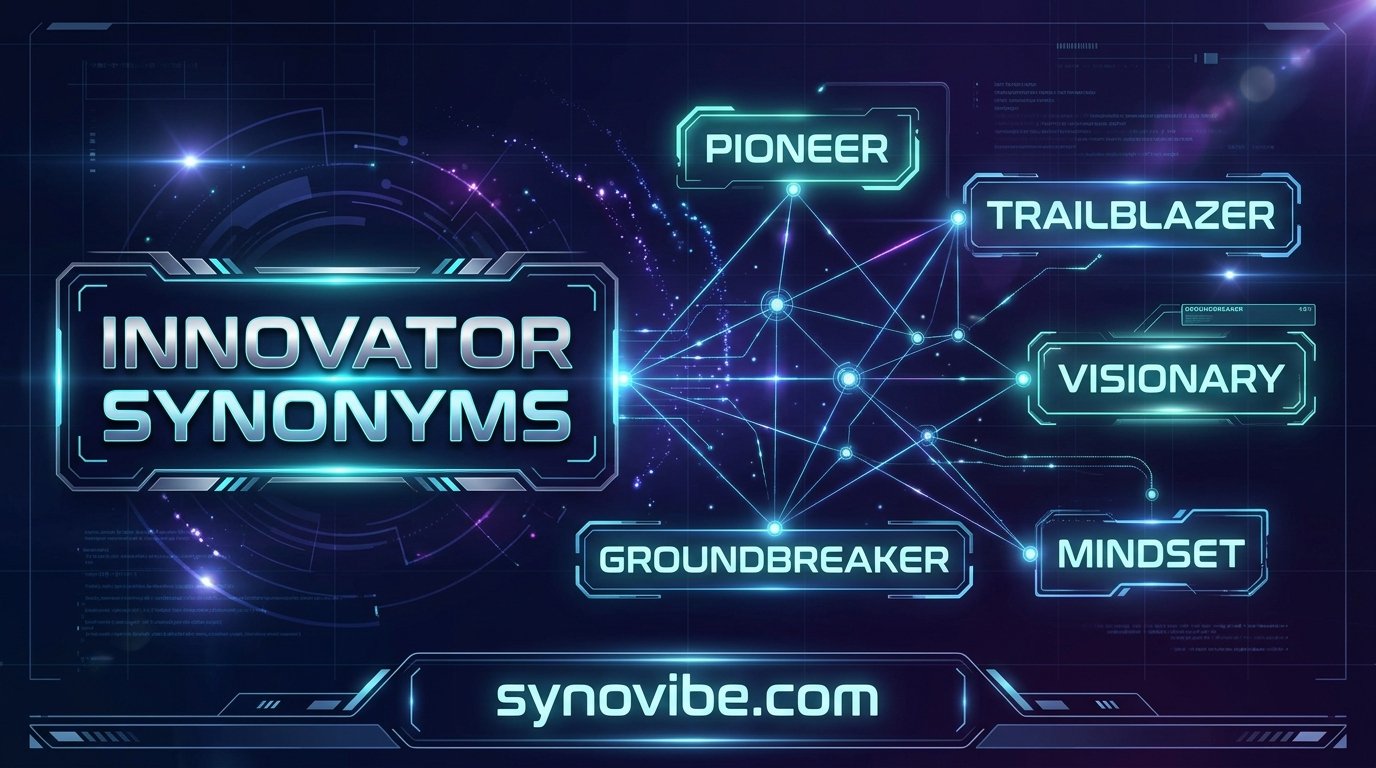
An innovator synonym is a word that describes someone who introduces new ideas, develops original solutions, or improves existing methods. Common synonyms for innovator include pioneer, trailblazer, visionary, inventor, creator, and groundbreaker.
Each word has a slightly different meaning, so choosing the right one depends on the situation. Whether you are writing an essay, improving your vocabulary, or describing a creative professional, understanding these alternatives will help you communicate more clearly and accurately.
Quick Answer: What Is a Synonym for Innovator?
The best synonyms for innovator include:
- Pioneer: Someone who is among the first to explore or develop something.
- Trailblazer: A person who creates a new path for others to follow.
- Inventor: Someone who creates a new device, product, or process.
- Visionary: A person who imagines new possibilities for the future.
- Groundbreaker: Someone who introduces important new ideas or methods.
- Creator: A person who brings something new into existence.
- Reformer: Someone who works to improve an existing system.
- Thinker: A person who develops ideas through careful thought.
Best overall synonym: Pioneer is an excellent general alternative when describing someone who introduces new ideas or leads the way in a new field.
However, inventor is more appropriate for someone who creates a new device, while visionary emphasizes imagination and future possibilities.
What Does Innovator Mean?
An innovator is a person who introduces new ideas, methods, products, or approaches. Innovators often challenge traditional ways of thinking and find better ways to solve problems.
Innovation can happen in almost any field, including technology, education, business, science, art, and healthcare.
For example,:
A teacher who develops an engaging new learning method can be called an innovator. Similarly, an entrepreneur who introduces a useful product or a scientist who develops a new research technique may also be described as an innovator.
Example Sentences Using Innovator
Here are several examples showing how to use the word naturally:
- The young entrepreneur became a successful innovator in the technology industry.
- Our school needs an innovator who can make learning more engaging.
- She is recognized as an innovator because of her creative approach to environmental problems.
- The company hired an innovator to develop new products.
- His reputation as an innovator grew after he introduced a more efficient production method.
What Are the Main Characteristics of an Innovator?
An innovator often demonstrates several important qualities:
- Creativity: The ability to develop original ideas.
- Curiosity: A desire to explore unfamiliar concepts.
- Problem-solving: The ability to identify challenges and develop solutions.
- Adaptability: A willingness to change approaches when necessary.
- Forward thinking: The ability to recognize new possibilities.
- Persistence: The determination to test and improve ideas.
An innovator does not always have to invent something entirely new. Improving an existing product, process, or service can also involve innovation.
30 Innovator Synonyms With Meanings and Examples
The following 30 words offer different ways to describe an innovator. Some are direct alternatives, while others emphasize particular aspects of innovation, such as creativity, leadership, invention, or improvement.
Understanding these differences will help you select the most accurate word for your writing.
1. Pioneer
Meaning: A person who is among the first to explore, develop, or introduce something.
Example: She was a pioneer in online education and helped make digital learning more accessible.
Best usage/context: Use pioneer when describing someone who establishes a new field, explores unfamiliar territory, or introduces an approach that others later adopt.
2. Trailblazer
Meaning: Someone who creates a new path and makes it easier for others to follow.
Example: The engineer became a trailblazer by developing accessible technology for people with disabilities.
Best usage/context: Use trailblazer when emphasizing leadership, courage, and the ability to challenge established practices.
3. Visionary
Meaning: A person who imagines new possibilities and thinks about the future.
Example: The visionary leader predicted that renewable energy would become increasingly important.
Best usage/context: This word works well when describing people with ambitious ideas, long-term plans, or a clear vision of future developments.
4. Inventor
Meaning: Someone who creates a new device, product, or process.
Example: The inventor designed a simple machine that reduced the time needed to complete the task.
Best usage/context: Use inventor when the innovation involves creating something new, especially a device, technology, or practical solution.
Important distinction: Not every innovator is an inventor. An innovator may improve an existing idea without creating an entirely new invention.
5. Groundbreaker
Meaning: A person who introduces something new or makes an important advance in a field.
Example: Her research was groundbreaking, and she became known as a groundbreaker in medical science.
Best usage/context: Use groundbreaker when emphasizing the importance or originality of someone’s contribution.
6. Creator
Meaning: A person who brings something into existence.
Example: The creator of the learning platform introduced several features that made studying easier.
Best usage/context: Use creator for people who develop products, services, content, designs, or original concepts.
Important distinction: A creator does not necessarily introduce a new method or challenge existing practices, so this word is broader than innovator.
7. Originator
Meaning: Someone who first develops or introduces an idea, plan, or method.
Example: She was the originator of the proposal to redesign the company’s customer service system.
Best usage/context: Use originator when you want to emphasize who first came up with an idea.
8. Reformer
Meaning: A person who works to improve an existing system, practice, or institution.
Example: The education reformer introduced new teaching methods to help struggling students.
Best usage/context: Use reformer when the innovation involves changing established systems, policies, or practices for the better.
9. Entrepreneur
Meaning: A person who starts or manages a business, often by pursuing a commercial opportunity.
Example: The entrepreneur launched a business that provided affordable solar equipment to rural communities.
Best usage/context: Use entrepreneur when discussing business creation, commercial opportunities, and the development of new products or services.
Important distinction: Entrepreneurs may be innovators, but not every entrepreneur introduces something innovative.
10. Developer
Meaning: A person who creates, builds, or improves a product, system, or process.
Example: The software developer created a tool that helped students organize their assignments.
Best usage/context: Use developer in technology, software, product design, and other fields involving the practical development of ideas.
11. Designer
Meaning: A person who plans or creates the form, appearance, or function of something.
Example: The designer developed a lightweight chair that was comfortable and easy to transport.
Best usage/context: Use designer when innovation involves product design, user experience, architecture, fashion, or visual communication.
12. Thinker
Meaning: Someone who develops, examines, or explores ideas carefully.
Example: The independent thinker questioned traditional assumptions and suggested a different approach.
Best usage/context: Use thinker when emphasizing intellectual creativity, reasoning, or the development of new perspectives.
Important distinction: A thinker may generate original ideas without putting them into practice.
13. Inventive Person
Meaning: Someone who is skilled at creating original ideas or finding clever solutions.
Example: As an inventive person, Maya found a simple way to reuse materials that would otherwise be discarded.
Best usage/context: Use this phrase when emphasizing resourcefulness and practical creativity rather than a person’s formal role.
14. Creative Mind
Meaning: A person who thinks imaginatively and develops original ideas.
Example: The company welcomed creative minds who could develop fresh approaches to familiar problems.
Best usage/context: This phrase is useful when describing artists, designers, writers, strategists, and people who generate original concepts.
15. Problem-Solver
Meaning: Someone who identifies problems and finds ways to resolve them.
Example: The team relied on Daniel as a problem-solver when the existing production process failed.
Best usage/context: Use problem-solver when an innovator’s main strength is finding effective solutions to practical challenges.
16. Changemaker
Meaning: A person who takes action to create meaningful change.
Example: The social entrepreneur became a changemaker by improving access to education in underserved communities.
Best usage/context: Use changemaker in discussions about social progress, community development, education, and organizational improvement.
17. Futurist
Meaning: A person who studies or anticipates possible future developments and trends.
Example: The futurist explored how advances in automation might change the workplace.
Best usage/context: Use futurist when describing someone who examines future possibilities and emerging trends.
Important distinction: A futurist may predict or analyze change without creating new products or methods.
18. Pathfinder
Meaning: A person who discovers or establishes a way forward.
Example: The researcher became a pathfinder in developing more accessible educational resources.
Best usage/context: Use pathfinder when emphasizing exploration, leadership, and finding new directions.
19. Experimentalist
Meaning: Someone who tests new ideas, methods, or techniques through experimentation.
Example: The experimentalist tested several teaching strategies to discover which worked best.
Best usage/context: Use this term when innovation depends on trying new approaches, conducting experiments, and learning from results.
20. Strategist
Meaning: A person who develops plans to achieve particular goals.
Example: The business strategist proposed a new approach to reaching customers in smaller markets.
Best usage/context: Use strategist when innovation involves planning, decision-making, and developing new ways to achieve objectives.
Important distinction: A strategist may create an innovative plan, but strategic thinking does not always involve innovation.
21. Architect
Meaning: A person who designs or plans a structure, system, or complex arrangement.
Example: She was the architect of the company’s new digital learning strategy.
Best usage/context: Use architect metaphorically when describing someone who designs a major system, initiative, or organizational transformation.
22. Reimaginer
Meaning: Someone who looks at an existing idea, system, or product in a new way.
Example: The designer was a reimaginer who transformed an ordinary workspace into a flexible learning environment.
Best usage/context: Use reimaginer when emphasizing the creative reinterpretation of something that already exists.
This is a descriptive term rather than a universally established job title.
23. Modernizer
Meaning: A person who updates something to make it more current, effective, or suitable for modern needs.
Example: The modernizer replaced outdated office procedures with a more efficient digital system.
Best usage/context: Use modernizer when the main goal is updating traditional systems, technologies, or practices.
24. Innovator at Heart
Meaning: A person who naturally enjoys creating new ideas and improving existing things.
Example: An innovator at heart, Daniel was always searching for better ways to organize his work.
Best usage/context: Use this expression in personal descriptions, informal writing, biographies, or motivational content.
It is a descriptive phrase rather than a direct single-word synonym.
25. Visionary Thinker
Meaning: Someone who combines imaginative thinking with an understanding of future possibilities.
Example: The visionary thinker proposed an entirely different approach to urban transportation.
Best usage/context: Use this phrase when you want to emphasize both intellectual creativity and forward-looking ideas.
26. Trendsetter
Meaning: A person who introduces a style, behavior, or approach that others begin to follow.
Example: The fashion designer became a trendsetter by introducing a distinctive clothing style.
Best usage/context: Use trendsetter in fashion, business, media, design, and popular culture.
Important distinction: A trendsetter influences what others adopt, but the word does not necessarily mean the person has developed a major technological or scientific innovation.
27. Disruptor
Meaning: A person or organization that challenges established ways of doing things and changes how an industry operates.
Example: The startup became a disruptor by offering an affordable alternative to traditional services.
Best usage/context: Use disruptor when innovation challenges established business models, industries, or conventional practices.
The word often appears in business and technology discussions.
28. Researcher
Meaning: A person who investigates questions, gathers evidence, and develops knowledge.
Example: The researcher discovered a more effective way to measure water quality.
Best usage/context: Use researcher when innovation emerges from investigation, testing, scientific study, or evidence-based exploration.
Important distinction: Research does not always produce innovation, although research can support important new discoveries and methods.
29. Experimental Thinker
Meaning: Someone who explores ideas by testing possibilities and questioning conventional approaches.
Example: As an experimental thinker, she tried several different approaches before finding a workable solution.
Best usage/context: Use this descriptive phrase when emphasizing curiosity, flexibility, and a willingness to test unfamiliar ideas.
30. Change Agent
Meaning: A person who actively helps introduce or implement change within an organization or community.
Example: The project manager became a change agent by helping the organization adopt a more efficient workflow.
Best usage/context: Use change agent in business, education, management, and organizational development.
Important distinction: A change agent helps bring about change, but the change does not necessarily have to be innovative.
Comparison Table: Which Innovator Synonym Is Best?
The best synonym depends on what you want to emphasize. Some words highlight originality, while others focus on leadership, invention, or improvement.
| Synonym | Main Meaning | Tone | Best Context |
| Pioneer | Among the first to develop something | Professional | New fields and discoveries |
| Trailblazer | Creates a path for others | Strong and inspiring | Leadership and achievement |
| Visionary | Imagines future possibilities | Aspirational | Leadership and future planning |
| Inventor | Creates something new | Technical | Devices, products, and inventions |
| Groundbreaker | Makes an important advance | Positive | Major achievements |
| Creator | Brings something into existence | General | Content, products, and ideas |
| Originator | First develops an idea | Neutral | Proposals and original concepts |
| Reformer | Improves an existing system | Professional | Education, policy, and institutions |
| Entrepreneur | Starts or manages a business | Business-focused | Startups and commercial ventures |
| Developer | Builds or improves a product or system | Professional | Software and product development |
| Designer | Plans the form or function of something | Creative | Design and user experience |
| Thinker | Explores ideas carefully | Intellectual | Essays and discussions |
| Problem-solver | Finds solutions to challenges | Practical | Workplaces and everyday problems |
| Changemaker | Creates meaningful change | Inspiring | Social impact and community work |
| Futurist | Studies possible future developments | Analytical | Technology and future trends |
| Pathfinder | Finds a way forward | Inspirational | Exploration and leadership |
| Experimentalist | Tests new ideas and methods | Technical | Research and experimentation |
| Strategist | Develops plans to achieve goals | Professional | Business and planning |
| Modernizer | Updates outdated systems | Professional | Digital transformation |
| Trendsetter | Introduces trends others follow | Informal to professional | Fashion, media, and culture |
| Disruptor | Challenges established practices | Business-focused | Industry transformation |
| Researcher | Investigates questions and evidence | Academic | Scientific and academic work |
| Change agent | Helps implement change | Professional | Organizational improvement |
The remaining expressions, such as creative mind, inventive person, reimaginer, and visionary thinker, are useful when you want to describe a person’s particular qualities rather than assign a formal role.
How to Choose the Right Innovator Synonym
Choosing the right word requires understanding the person’s contribution, the tone of your writing, and the message you want to communicate.
1. Choose a Synonym Based on Tone
Different words create different impressions.
For professional writing
Use:
- Innovator
- Pioneer
- Developer
- Originator
- Strategist
Example: The company hired an innovator to improve its product development process.
These terms work well in business reports, professional biographies, and workplace communication.
For inspiring or motivational writing
Use:
- Trailblazer
- Visionary
- Groundbreaker
- Pathfinder
- Changemaker
Example: She became a trailblazer by challenging traditional expectations and creating new opportunities.
These words emphasize courage, ambition, leadership, and positive influence.
For academic writing
Use:
- Researcher
- Inventor
- Pioneer
- Originator
- Experimentalist
Example: The researcher introduced a new method for analyzing the results.
Choose a term that accurately describes the person’s contribution rather than simply selecting the most impressive-sounding word.
For casual writing
Use:
- Creative mind
- Problem-solver
- Trendsetter
- Inventive person
Example: My brother is a natural problem-solver who always finds clever solutions.
These expressions sound natural in everyday conversations and personal descriptions.
2. Choose a Synonym Based on Meaning
Ask yourself what makes the person innovative.
If the person introduces something for the first time: Choose pioneer or originator.
If the person creates a new device: Choose inventor.
If the person imagines future possibilities: Choose visionary.
If the person improves an existing system: Choose reformer or modernizer.
If the person challenges an established industry: Choose disruptor.
If the person develops creative solutions: Choose problem-solver or creative mind.
If the person introduces a popular new style: Choose trendsetter.
The more precisely you identify the person’s contribution, the easier it becomes to choose an appropriate synonym.
3. Choose a Synonym Based on Intent
Your writing goal also affects your choice.
| Your Goal | Recommended Word | Example |
| Highlight leadership | Trailblazer | She is a trailblazer in educational technology. |
| Emphasize originality | Originator | He was the originator of the new proposal. |
| Describe invention | Inventor | The inventor developed a new device. |
| Praise future thinking | Visionary | The visionary anticipated new opportunities. |
| Describe business innovation | Entrepreneur | The entrepreneur introduced a new service. |
| Emphasize practical solutions | Problem-solver | She is an effective problem-solver. |
| Highlight social improvement | Changemaker | The changemaker expanded access to education. |
| Describe system improvement | Reformer | The reformer introduced new educational policies. |
4. Consider the Field
Some synonyms work better in specific industries.
- Technology: Innovator, developer, inventor, disruptor.
- Education: Pioneer, reformer, educational innovator.
- Business: Entrepreneur, strategist, trailblazer.
- Science: Researcher, inventor, pioneer.
- Art and design: Creator, designer, creative mind.
- Social development: Changemaker, reformer, change agent.
- Fashion and media: Trendsetter, creator, visionary.
These are useful general guidelines, not strict rules. The most accurate word depends on the person’s actual role and achievements.
Common Mistakes When Using Innovator Synonyms
Although many words are related to innovation, they are not always interchangeable. Avoiding the following mistakes will make your writing clearer.
1. Using Inventor for Every Innovator
An inventor creates something new, such as a device, machine, or process. An innovator may instead improve an existing product or introduce a more effective way of working.
Incorrect assumption: Every innovator must invent something.
Better understanding: An innovator can introduce meaningful improvements without creating an entirely new invention.
2. Confusing Visionary With Innovator
A visionary imagines new possibilities, while an innovator introduces or implements new ideas.
For example, someone may imagine a future transportation system without developing or implementing it.
Tip: Use visionary to emphasize future-oriented thinking and innovator to emphasize the introduction or application of new ideas.
3. Treating Entrepreneur as an Exact Synonym
An entrepreneur starts or manages a business. An innovator introduces new ideas or improvements.
One person may be both, but the terms describe different qualities.
Example: A person who opens a traditional retail store is an entrepreneur, even if the business does not introduce anything innovative.
4. Using Pioneer Without Considering Context
A pioneer is often among the first to explore or develop something. The word may be unsuitable when someone simply adopts an existing method.
Tip: Use pioneer when the person makes an early or foundational contribution.
5. Assuming Every Change Agent Is an Innovator
A change agent helps implement change, but the change may involve adopting an established process rather than developing a new idea.
Tip: Use change agent when the emphasis is on implementing change, not necessarily creating something original.
6. Choosing Impressive Words Instead of Accurate Ones
Words such as visionary, trailblazer, and groundbreaker can sound powerful, but they should reflect the person’s actual contribution.
For example, calling someone a groundbreaker may exaggerate their role if they simply follow a widely used approach.
Tip: Accuracy is more important than making a description sound impressive.
FAQs:
1. What Is the Best Synonym for Innovator?
Pioneer is one of the best general synonyms for innovator. It describes someone who introduces or develops something new, often creating opportunities for others to follow.
However, inventor is better for someone who creates a new device, while visionary is better for someone known for imagining future possibilities.
2. What Is Another Word for Innovator in Business?
Common business alternatives include pioneer, entrepreneur, trailblazer, disruptor, developer, and visionary.
The best choice depends on the person’s role. Use entrepreneur for someone who starts a business, disruptor for someone who challenges an established industry, and pioneer for someone who introduces an early or influential approach.
3. What Is a Synonym for an Innovative Person?
You can describe an innovative person as a creative thinker, inventive person, pioneer, problem-solver, or visionary.
Use creative thinker to emphasize original ideas, problem-solver to emphasize practical solutions, and pioneer to highlight leadership in a developing field.
4. Is Pioneer the Same as Innovator?
The words have similar meanings, but they are not identical.
A pioneer is often one of the first people to explore or develop something. An innovator introduces new ideas, products, or methods, even if the field already exists.
A person can be both a pioneer and an innovator.
5. What Is the Difference Between an Innovator and an Inventor?
An innovator introduces new ideas or improves existing products, services, and processes. An inventor creates something new, often a device, technology, or practical method.
For example, someone who improves an existing educational platform may be an innovator. Someone who creates a new type of educational device may be an inventor.
6. What Is a More Professional Word for Innovator?
Professional alternatives include pioneer, originator, developer, strategist, and innovation leader.
For a business report, innovation leader may be appropriate when describing someone who leads innovation efforts. For a technical role, developer or inventor may be more accurate.
Choose the term that best reflects the person’s responsibilities.
7. What Is the Opposite of Innovator?
There is no single perfect opposite of innovator, because the word describes someone who introduces new ideas.
Depending on the context, possible opposites include:
- Traditionalist: Someone who prefers established customs and methods.
- Conventional thinker: Someone who tends to follow accepted ideas and practices.
- Conservative thinker: Someone who prefers preserving existing arrangements, depending on the context.
- Resister to change: Someone who actively opposes change.
These terms have different meanings and should not automatically be treated as interchangeable.
8. How Can I Use Innovator Synonyms in a Sentence?
Choose a synonym that matches the person’s contribution.
Examples:
- The pioneer introduced a new approach to online education.
- The inventor created a device that reduced energy consumption.
- The visionary developed a long-term plan for sustainable transportation.
- The reformer improved the school’s outdated teaching practices.
- The entrepreneur launched a service that addressed an unmet customer need.
Using specific words helps readers understand exactly what makes a person innovative.
Conclusion
Choosing the right innovator synonym can make your writing more precise, engaging, and meaningful. Words such as pioneer, trailblazer, visionary, inventor, and groundbreaker are useful alternatives, but each emphasizes a different aspect of innovation.
Use pioneer when someone leads the way in a new field, inventor when someone creates something new, and visionary when someone imagines future possibilities. For business writing, entrepreneur or disruptor may be more appropriate, depending on the context.
The key is to understand the person’s contribution before choosing a replacement. By selecting words according to their meaning, tone, and purpose, you can improve your vocabulary and communicate your ideas with greater confidence.

Logan Foster is a content writer who enjoys exploring vocabulary, synonyms, and the many ways to express an idea. He creates clear, practical content that helps readers discover alternative words, improve their writing, and communicate more effectively.