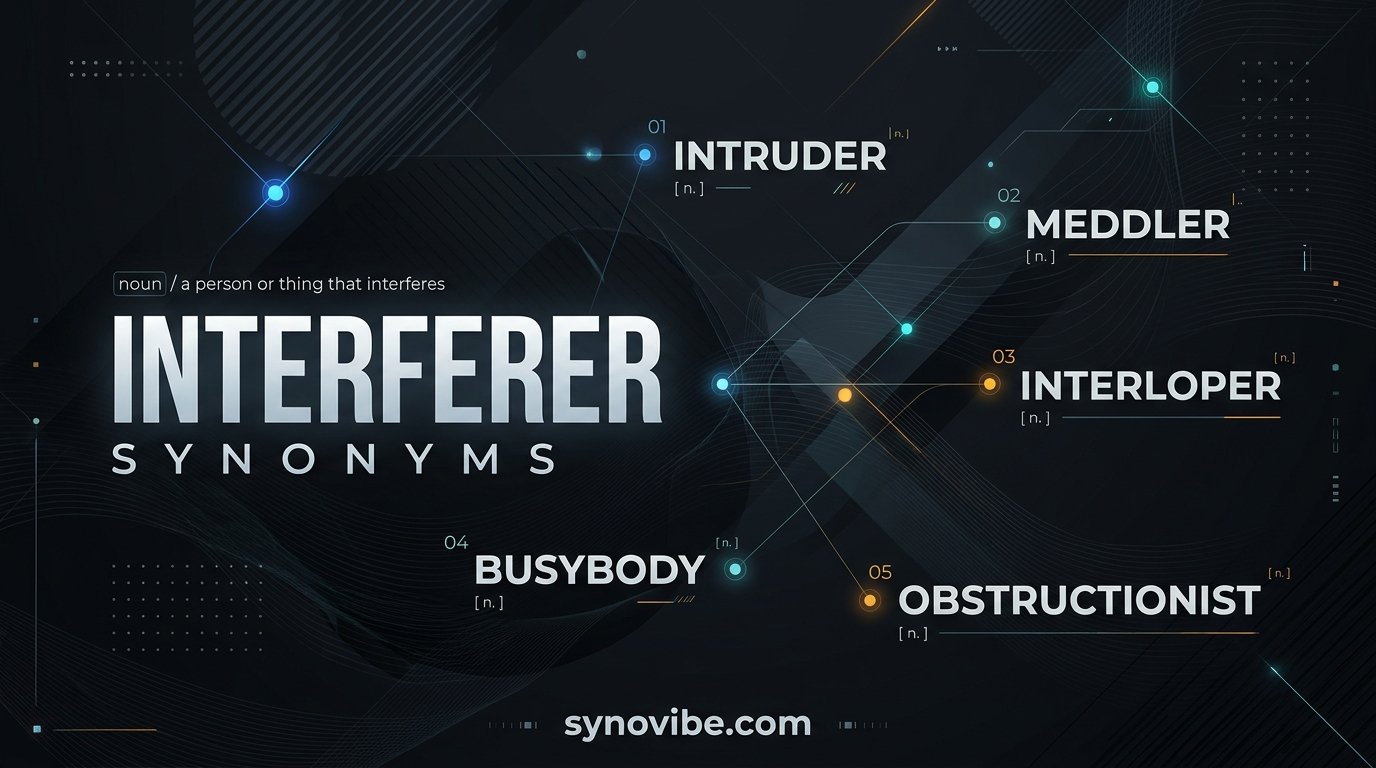
Finding the right interferer synonym can help you describe someone or something that interrupts progress, disrupts an activity, or gets involved in another person’s affairs. Common alternatives include meddler, intruder, interrupter, obstructionist, disruptor, and interloper.
However, each word has a slightly different meaning. Some describe a person who interferes in private matters, while others refer to someone who interrupts a process or creates obstacles. Understanding these differences will help you choose the most accurate word for everyday conversations, academic writing, and professional communication.
Quick Answer: What Is a Synonym for Interferer?
The best synonyms for interferer include meddler, intruder, interrupter, interloper, disruptor, obstructionist, and busybody.
An interferer is someone who unnecessarily gets involved in a situation, interrupts an activity, or prevents others from doing something without interference.
Choose the word according to the situation:
- Meddler: Someone who interferes in other people’s affairs.
- Busybody: Someone who takes too much interest in other people’s business.
- Intruder: Someone who enters a place or situation without permission.
- Interrupter: Someone who stops another person while they are speaking or working.
- Disruptor: Someone or something that interrupts normal activities.
- Interloper: Someone who becomes involved in a situation where they are not wanted.
- Obstructionist: Someone who deliberately prevents progress.
Meaning and Usage of Interferer
What Does Interferer Mean?
The noun interferer refers to a person who interferes with another person’s activities, decisions, relationships, or responsibilities. It can also describe someone who disrupts a process or prevents an activity from proceeding normally.
The word often has a negative meaning because interference can be unwanted, unnecessary, or intrusive.
Examples:
- My neighbor is an interferer who constantly comments on our family decisions.
- The manager asked the interferer to stop interrupting the team’s discussion.
- The referee prevented an interferer from disrupting the match.
In these examples, the interferer either gets involved where they are not needed or interrupts an activity.
Is Interferer a Positive or Negative Word?
Interferer is generally a negative word because it suggests unwanted involvement or disruption.
However, the word interference does not always describe something harmful. For example, a person might intervene to prevent an accident or protect someone from danger. In such situations, words like helper, mediator, or protector may be more appropriate.
When Should You Use an Interferer Synonym?
Use an alternative word when you want to describe the specific type of interference involved.
For example:
- Use meddler when someone interferes in personal decisions.
- Use busybody when someone constantly asks questions about other people’s affairs.
- Use intruder when someone enters a private space without permission.
- Use interrupter when someone repeatedly stops others from speaking.
- Use obstructionist when someone deliberately blocks progress.
- Use interloper when someone becomes involved in a situation without being welcome.
Choosing the right word makes your writing more precise and helps readers understand your intended meaning.
30 Synonyms for Interferer With Meanings and Examples
The following 30 words describe different forms of interference. Some are direct alternatives, while others are related terms that apply to particular situations.
1. Meddler
Meaning: A person who interferes in other people’s affairs without being invited.
Example: My uncle is a meddler who always tries to control our family decisions.
Best usage/context: Use meddler when describing someone who unnecessarily involves themselves in personal matters.
2. Busybody
Meaning: Someone who is overly interested in other people’s private lives.
Example: The busybody next door always wants to know who visits our house.
Best usage/context: Best for informal conversations about people who gossip, ask intrusive questions, or interfere in private affairs.
3. Intruder
Meaning: A person who enters a place or situation without permission.
Example: The security guard escorted the intruder out of the restricted area.
Best usage/context: Use intruder when interference involves unauthorized entry or an unwanted presence.
4. Interrupter
Meaning: Someone who interrupts another person or stops an activity temporarily.
Example: The teacher asked the interrupter to wait until the speaker had finished.
Best usage/context: Appropriate for conversations, meetings, presentations, and other situations where someone repeatedly interrupts.
5. Interloper
Meaning: A person who becomes involved in a situation where they are not welcome or do not belong.
Example: He felt like an interloper when he joined a private discussion without an invitation.
Best usage/context: Use this word when emphasizing that someone is an unwelcome outsider.
6. Disruptor
Meaning: A person or thing that interrupts normal activities or changes an established process.
Example: The disruptive visitor became a disruptor during the community meeting.
Best usage/context: Suitable for workplaces, public gatherings, organizations, and situations involving interruptions or disorder.
7. Obstructionist
Meaning: Someone who deliberately prevents progress or makes it difficult for others to accomplish something.
Example: The obstructionist refused to support any proposal, even after the team addressed his concerns.
Best usage/context: Particularly useful in political, organizational, and formal discussions about deliberate obstruction.
8. Meddler-in-chief
Meaning: An informal expression for someone who takes the leading role in interfering in other people’s affairs.
Example: Everyone jokingly called her the meddler-in-chief because she tried to manage every family disagreement.
Best usage/context: Use humorously or critically in informal writing. It is an expression rather than a standard one-word synonym.
9. Busybodying Person
Meaning: Someone who regularly involves themselves in matters that do not concern them.
Example: The busybodying person kept asking the couple about their private plans.
Best usage/context: This is a descriptive phrase rather than a conventional synonym. In most cases, busybody sounds more natural.
10. Troublemaker
Meaning: A person who causes problems, arguments, or conflict.
Example: The troublemaker spread rumors that created tension among the employees.
Best usage/context: Use this word when the interference creates problems or encourages conflict.
11. Agitator
Meaning: Someone who encourages people to protest, argue, or take action, often by creating dissatisfaction.
Example: The agitator tried to turn a peaceful discussion into a heated argument.
Best usage/context: Useful in political, social, and organizational contexts. An agitator is not necessarily an interferer because agitation can also involve legitimate advocacy.
12. Meddlesome Person
Meaning: Someone who tends to interfere in matters that are not their responsibility.
Example: The meddlesome person kept offering unwanted advice about our business.
Best usage/context: Use this descriptive phrase when emphasizing a person’s habit of interfering.
13. Intervener
Meaning: A person who steps into a situation to influence or change what is happening.
Example: The intervener entered the discussion to resolve the disagreement.
Best usage/context: Appropriate in formal, legal, diplomatic, or conflict-resolution contexts. Unlike meddler, an intervener may have a legitimate reason to act.
14. Intrusive Person
Meaning: Someone who enters other people’s personal space, privacy, or affairs without appropriate boundaries.
Example: The intrusive person kept asking questions about her financial situation.
Best usage/context: Best when the interference involves personal boundaries or privacy.
15. Interfering Party
Meaning: A person or group that becomes involved in a situation and affects its outcome.
Example: The interfering party complicated the negotiations by introducing unrelated demands.
Best usage/context: Suitable for formal discussions, negotiations, disputes, and business matters.
16. Obstructer
Meaning: Someone who blocks, hinders, or prevents an action from progressing.
Example: The obstructer repeatedly delayed the team’s efforts to finish the project.
Best usage/context: Use when the focus is on preventing progress. Obstructor is also used, and both forms are less common than obstructionist in many contexts.
17. Saboteur
Meaning: A person who deliberately damages, undermines, or disrupts an activity, plan, or organization.
Example: The saboteur deleted important files to delay the project’s completion.
Best usage/context: Use when interference is intentional and involves damaging or undermining something. It is stronger than interferer.
18. Agitator-in-Chief
Meaning: An informal expression for someone who leads or frequently encourages agitation and conflict.
Example: His colleagues called him the agitator-in-chief because he regularly encouraged arguments during meetings.
Best usage/context: Suitable for humorous or critical commentary, particularly about leadership in disputes. It is not a direct synonym in every context.
19. Provocateur
Meaning: Someone who deliberately provokes reactions, arguments, or controversy.
Example: The provocateur made inflammatory comments to provoke the audience.
Best usage/context: Use in political, artistic, social, or public-discussion contexts where someone intentionally provokes others.
20. Disturber
Meaning: A person who interrupts peace, quiet, or normal activities.
Example: The disturber repeatedly shouted during the lecture.
Best usage/context: Understandable in general English, although disruptor, troublemaker, or person causing a disturbance may sound more natural in many situations.
21. Meddling Individual
Meaning: A person who unnecessarily interferes in another person’s affairs.
Example: The meddling individual tried to influence the couple’s decision about where to live.
Best usage/context: Useful in formal or descriptive writing when you want to emphasize unwanted involvement without using an informal label.
22. Gatecrasher
Meaning: Someone who attends an event without an invitation or permission.
Example: The gatecrasher entered the wedding reception without being invited.
Best usage/context: Use for unwanted attendance at parties, celebrations, private functions, or similar events. A gatecrasher is not necessarily an interferer in other circumstances.
23. Busybody Neighbor
Meaning: A neighbor who takes excessive interest in other people’s private lives.
Example: Our busybody neighbor keeps questioning everyone about their weekend plans.
Best usage/context: An informal descriptive phrase for neighborhood gossip or intrusive curiosity.
24. Heckler
Meaning: Someone who interrupts a speaker or performer with critical, mocking, or disruptive remarks.
Example: The comedian continued performing despite the heckler in the front row.
Best usage/context: Best for speeches, public events, performances, and political meetings.
25. Antagonist
Meaning: A person who opposes another person or creates conflict with them.
Example: The antagonist repeatedly challenged the leader’s decisions.
Best usage/context: Common in literature, storytelling, and descriptions of personal or professional conflict. An antagonist is not necessarily an interferer unless they actually disrupt or interfere with something.
26. Opponent
Meaning: Someone who competes against or disagrees with another person.
Example: Her opponent challenged the proposal during the debate.
Best usage/context: Use in sports, elections, competitions, and disagreements. Opposition alone does not mean interference.
27. Saboteur of Progress
Meaning: A person who deliberately undermines efforts to achieve progress.
Example: The team viewed him as a saboteur of progress because he repeatedly damaged completed work.
Best usage/context: A descriptive phrase for serious, deliberate interference with plans or development.
28. Disrupter
Meaning: A person or thing that interrupts normal activities or established arrangements.
Example: The disrupter repeatedly interrupted the training session.
Best usage/context: An alternative spelling of disruptor. Both forms are used, and the preferred form may depend on the style guide or context.
29. Meddling Outsider
Meaning: A person from outside a group who interferes in its internal affairs.
Example: The family ignored the meddling outsider who tried to influence their inheritance decisions.
Best usage/context: Use when the person’s outsider status is important to the situation. This is a descriptive phrase, not a fixed synonym.
30. Busybody Interferer
Meaning: A person who repeatedly interferes because of excessive curiosity about other people’s affairs.
Example: The busybody interferer kept asking the staff about their manager’s private life.
Best usage/context: Suitable for informal or expressive writing. Usually, busybody or meddler is more concise and natural.
Important note: These 30 options are not interchangeable in every sentence. Words such as meddler, interloper, and interrupter describe different types of interference, while terms such as opponent and antagonist are related words rather than direct synonyms.
Comparison Table: Choosing the Best Interferer Synonym
Use this table to compare common alternatives according to their meanings, tone, and typical contexts.
| Synonym | Main Meaning | Tone | Best Context |
| Meddler | Interferes in personal affairs | Negative | Family and relationships |
| Busybody | Takes excessive interest in others’ lives | Informal, critical | Gossip and private matters |
| Intruder | Enters without permission | Strong, negative | Private spaces and restricted areas |
| Interrupter | Stops someone from speaking or working | Neutral to negative | Conversations and meetings |
| Interloper | Gets involved where unwelcome | Negative | Social groups and private affairs |
| Disruptor | Interrupts normal activities | Neutral to negative | Workplaces and public events |
| Obstructionist | Deliberately blocks progress | Strong, critical | Politics and organizations |
| Troublemaker | Causes problems or conflict | Informal, negative | Schools, workplaces, and groups |
| Saboteur | Deliberately undermines something | Strong, negative | Projects and organizations |
| Agitator | Encourages agitation or protest | Context-dependent | Politics and social movements |
| Intervener | Steps into a situation | Neutral | Conflict resolution |
| Provocateur | Deliberately provokes reactions | Critical or descriptive | Public debate and controversy |
| Intrusive person | Invades privacy or personal boundaries | Negative | Personal relationships |
| Heckler | Disrupts a speaker or performer | Negative | Public speaking and entertainment |
| Gatecrasher | Attends without an invitation | Informal, negative | Parties and private events |
Which Interferer Synonym Is Most Accurate?
The best choice depends on the behavior you want to describe.
- For someone who interferes in family matters: Meddler.
- For someone who constantly asks personal questions: Busybody.
- For someone who interrupts conversations: Interrupter.
- For someone who enters without permission: Intruder.
- For someone who interferes in a group without being welcome: Interloper.
- For someone who blocks a project: Obstructionist.
- For someone who deliberately damages a plan: Saboteur.
- For someone who disrupts a public speech: Heckler.
These distinctions are important because using a stronger word than the situation requires can make your writing sound unfair or inaccurate.
How to Choose the Right Synonym for Interferer
Choosing an appropriate synonym requires considering the person’s behavior, the situation, and the tone of your writing.
1. Choose According to Tone
The tone of a word determines how readers interpret your description.
Neutral or relatively formal words
- Intervener
- Interfering party
- Disruptor
- Interrupter
These words can describe someone’s actions without necessarily suggesting bad intentions.
Informal or critical words
- Meddler
- Busybody
- Troublemaker
- Gatecrasher
These words are useful in everyday conversations and informal writing.
Strongly negative words
- Saboteur
- Obstructionist
- Provocateur
These words suggest deliberate disruption, obstruction, or provocation. Use them when the situation supports that meaning.
2. Choose According to Meaning
Consider exactly how the interference happens.
Interference in private matters
Use meddler, busybody, or intrusive person when someone crosses personal boundaries or becomes involved in private decisions.
Example: “My cousin is a meddler who always comments on my career choices.”
Interference in conversations
Use interrupter or heckler when someone stops a speaker from communicating.
Example: “The interrupter prevented the audience from hearing the full explanation.”
Interference with progress
Use obstructionist or obstructer when someone makes it difficult to complete a task.
Example: “The obstructionist delayed approval of the new project.”
Interference through deliberate damage
Use saboteur when someone intentionally undermines a plan or activity.
Example: “The saboteur damaged the equipment before the demonstration.”
Unwanted involvement in a group
Use interloper when someone becomes involved in a situation where they are unwelcome.
Example: “The interloper tried to influence a private conversation.”
3. Choose According to Intent
A person’s intention can help determine which word fits best.
Unwanted but possibly well-intentioned involvement: Use meddler when someone offers unsolicited advice or interferes in personal matters.
Disruption without a clear motive: Use disruptor when someone interrupts an activity but their intention is unknown.
Deliberate obstruction: Use obstructionist when someone intentionally prevents progress.
Intentional damage: Use saboteur when someone deliberately undermines a project or system.
Legitimate intervention: Use intervener when someone steps into a situation to help resolve a problem or influence an outcome.
Remember that interference and intervention are not always the same. Interference often suggests unwanted involvement, while intervention may be necessary, helpful, or justified.
Common Mistakes When Using Interferer Synonyms
Understanding common mistakes can help you select more accurate words.
1. Using Meddler and Intruder Interchangeably
A meddler interferes in other people’s affairs, while an intruder enters a place or situation without permission.
Incorrect: “The intruder kept giving me unwanted advice about my marriage.”
This sentence may be understandable, but meddler is more accurate if the person did not enter a restricted place.
Better: “The meddler kept giving me unwanted advice about my marriage.”
2. Using Opponent as a Direct Synonym
An opponent is someone who competes against or disagrees with another person. An opponent does not necessarily interfere with anything.
Example: “Her opponent presented a different argument during the debate.”
This describes disagreement, not necessarily interference.
Use obstructionist if the person deliberately prevents progress.
3. Confusing Intervener With Meddler
An intervener steps into a situation, while a meddler usually gets involved unnecessarily.
Example: “The teacher intervened to stop the argument.”
The teacher’s involvement may be justified, so intervener is more appropriate than meddler.
4. Calling Every Disruptive Person a Saboteur
A saboteur deliberately undermines or damages something. A person who causes an accidental interruption is not necessarily a saboteur.
Incorrect: “The student was a saboteur because he accidentally interrupted the presentation.”
Better: “The student interrupted the presentation.”
Use saboteur only when deliberate undermining or damage is involved.
5. Using Busybody in Formal Writing
Busybody is informal and often judgmental. It may be unsuitable for professional reports or academic writing.
Instead of writing:
“The busybody kept asking about confidential information.”
Consider:
“The individual repeatedly asked inappropriate questions about confidential information.”
The second version is more neutral and professional.
6. Assuming Interferer Always Describes a Person
Although interferer generally refers to a person, the related noun interference can describe many other things, including noise, signals, or obstacles.
For example:
- Radio interference affected the signal.
- Construction noise disrupted the meeting.
- A person interfered with the investigation.
Choose a word that accurately describes whether the problem involves a person, an action, or an external condition.
FAQs:
1. What Is the Most Common Synonym for Interferer?
Meddler is one of the most common alternatives when describing someone who unnecessarily interferes in other people’s affairs. Other choices include busybody, interrupter, and interloper, depending on the situation.
2. What Is Another Word for Someone Who Interferes in Everything?
Words such as meddler and busybody describe someone who frequently interferes in other people’s lives. Busybody emphasizes excessive curiosity, while meddler emphasizes unwanted involvement.
3. What Is a Formal Word for Interferer?
Depending on the context, formal alternatives include intervening party, obstructionist, and disruptor. For professional writing, a descriptive phrase such as “a person who interferes with the process” may be more precise.
4. What Is the Difference Between an Interferer and a Meddler?
An interferer is a general term for someone who disrupts an activity or gets involved in a situation. A meddler specifically interferes in matters that concern other people, often without being asked.
For example, someone who interrupts a meeting may be an interferer, while someone who tries to control another person’s marriage is a meddler.
5. What Is a Synonym for an Interferer in a Relationship?
Meddler, busybody, and intrusive person are useful choices when describing someone who interferes in a relationship.
For example: “Her friend became a meddler by repeatedly trying to control the couple’s decisions.”
6. What Is the Difference Between an Interferer and an Interloper?
An interferer disrupts or becomes involved in a situation. An interloper is someone who enters a group, activity, or situation where they are unwelcome or do not belong.
An interloper may also interfere, but the word emphasizes their unwelcome presence.
7. Is Disruptor a Synonym for Interferer?
Yes, disruptor can be a synonym when the person interrupts normal activities or prevents a process from continuing smoothly. However, it does not always imply inappropriate involvement in personal matters.
For example, someone who repeatedly interrupts a meeting could be described as a disruptor.
8. What Is the Opposite of Interferer?
There is no single perfect opposite because the meaning of interferer depends on the context. Possible contrasting terms include supporter, helper, mediator, and facilitator.
A facilitator helps an activity proceed smoothly, while a meddler unnecessarily interferes in other people’s affairs. The most suitable opposite depends on the specific behavior being described.
Conclusion
Choosing the right interferer synonym helps you describe unwanted involvement, interruptions, and obstacles more clearly. Words such as meddler, busybody, interrupter, interloper, disruptor, and obstructionist each express a different kind of interference.
For personal matters, meddler and busybody are often suitable. For interruptions, choose interrupter or heckler. For deliberate obstruction, obstructionist may be more precise, while saboteur describes intentional damage or undermining.
The key is to consider the meaning, tone, and intention behind the behavior before selecting a synonym. By understanding these differences, you can communicate more naturally and make your English writing clearer, more accurate, and more effective.

Charlotte Davis is a content writer with a passion for words, vocabulary, and the art of clear communication. She creates helpful content about synonyms and word choices, helping readers discover alternative expressions and communicate with greater clarity and confidence.