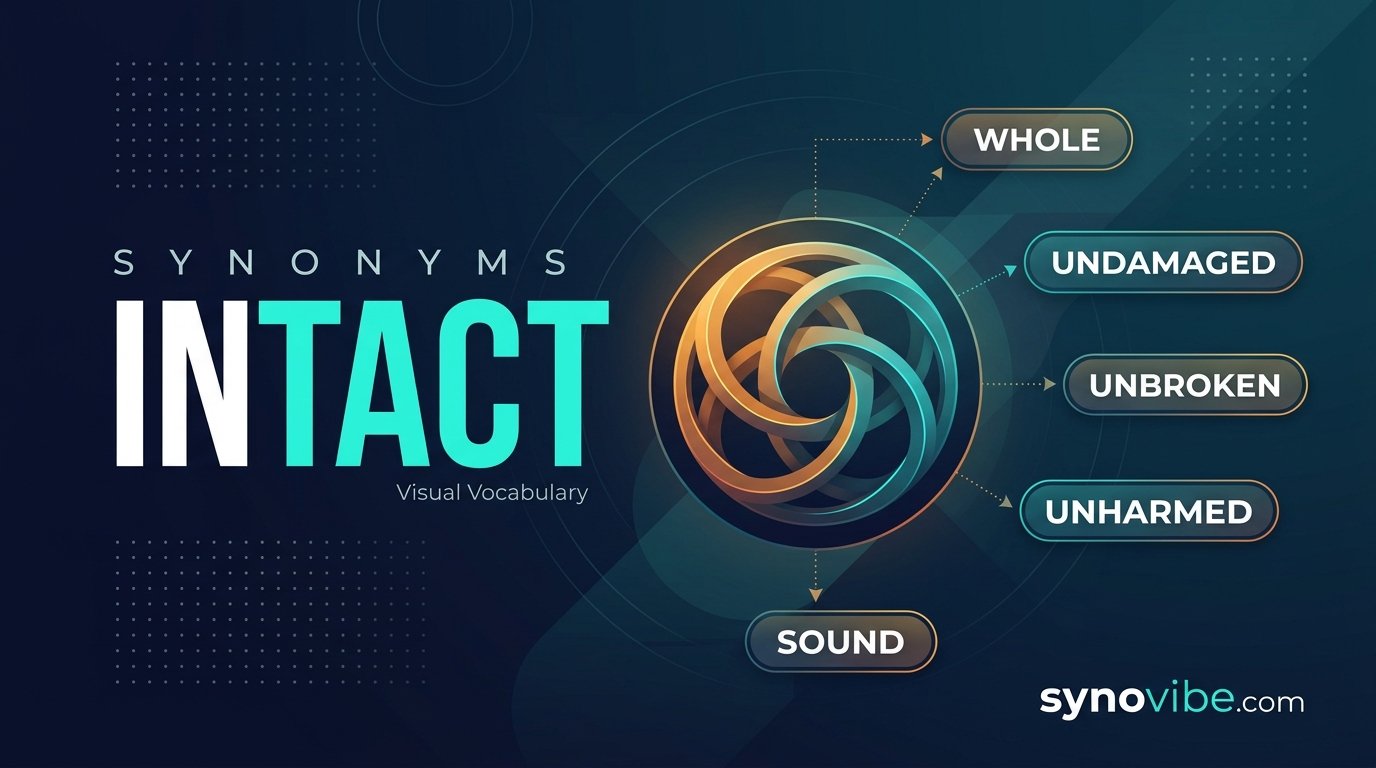
The best synonyms for intact include undamaged, whole, unbroken, complete, untouched, preserved, and unharmed. These words describe something that remains in its original condition, has not been damaged, or has retained all its essential parts. However, the best alternative depends on the context.
For example, unbroken works well for a glass object, unharmed describes a person, and preserved emphasizes maintaining something over time. Understanding these differences will help you choose the right word for essays, conversations, professional writing, and everyday English.
Quick Answer: What Is a Synonym for Intact?
A synonym for intact is a word that describes something that remains whole, complete, undamaged, or unaffected.
Here are some of the most useful alternatives:
- Undamaged: Not harmed or broken.
- Whole: Complete, with all parts present.
- Unbroken: Not cracked, split, or broken.
- Complete: Having all necessary parts.
- Untouched: Not handled, changed, or affected.
- Unharmed: Not physically injured or damaged.
- Preserved: Kept in good condition.
- Unspoiled: Not ruined or damaged.
- Sound: In good condition and free from damage.
- Unaltered: Not changed from the original state.
Best overall synonym: Undamaged is often the closest alternative when intact describes something that has not suffered physical damage.
What Does Intact Mean?
The word intact is an adjective that describes something that remains whole, complete, or undamaged. It can also describe something that has not been changed, disturbed, or affected.
In simple English, if something is intact, it is still in good condition, with its important parts remaining as they were.
Examples of Intact in Sentences
- The package arrived intact despite the long journey.
- Fortunately, the historical building remained intact after the storm.
- She managed to keep her phone intact during the trip.
- The team emerged from the difficult experience with its confidence intact.
- The ancient document was found intact inside a protective case.
These examples show that intact can describe physical objects, buildings, documents, relationships, reputations, and abstract qualities.
Different Uses of Intact
1. Physical condition
When describing an object, intact usually means that it is not broken or damaged.
Example: The glass bottle remained intact after falling onto the carpet.
2. Completeness
Intact can mean that all parts of something remain together.
Example: The collector was delighted to find the puzzle intact, with every piece included.
3. Original condition
The word can describe something that has not been changed or disturbed.
Example: The archaeologists discovered an intact ancient tomb.
4. Abstract qualities
Intact can also describe qualities such as trust, dignity, privacy, or reputation that have survived a difficult experience.
Example: Despite the disagreement, their friendship remained intact.
30 Synonyms for Intact With Meanings and Examples
The following 30 words and expressions can replace intact in suitable contexts. Some are direct synonyms, while others describe particular aspects of being intact. Always consider the meaning of the complete sentence before choosing a replacement.
1. Undamaged
Meaning: Not harmed, broken, or physically damaged.
Example: The delivery driver handed us the package completely undamaged.
Best usage/context: Use undamaged when describing objects, buildings, products, vehicles, or other things that have avoided physical damage.
Example replacement: The box remained intact. → The box remained undamaged.
2. Whole
Meaning: Complete, with all parts present and connected.
Example: After searching the garden, we finally found the whole flowerpot.
Best usage/context: Use whole when emphasizing that something is complete rather than divided, broken, or missing parts.
Example replacement: The plate was intact. → The plate was whole.
3. Unbroken
Meaning: Not broken into pieces or separated by a crack or fracture.
Example: The antique vase survived the move unbroken.
Best usage/context: Use unbroken for glass, pottery, objects, bones, and other things that can physically break.
Example replacement: The mirror remained intact. → The mirror remained unbroken.
4. Complete
Meaning: Having all the necessary parts or elements.
Example: The researcher submitted a complete set of historical records.
Best usage/context: Use complete when emphasizing that nothing essential is missing. Unlike intact, it does not always mean that something is physically undamaged.
Example replacement: The collection remained intact. → The collection remained complete.
5. Untouched
Meaning: Not handled, disturbed, changed, or affected.
Example: The cookies remained untouched on the kitchen table.
Best usage/context: Use untouched when something has not been used, disturbed, or altered.
Example replacement: The original painting remained intact. → The original painting remained untouched.
Important distinction: Something can be untouched without being physically perfect, and something can be intact even after it has been handled.
6. Unharmed
Meaning: Not injured or harmed.
Example: Everyone escaped the building unharmed.
Best usage/context: Use unharmed primarily for people and animals, and sometimes for living things or entities that could suffer harm.
Example replacement: The passengers remained intact. → The passengers remained unharmed.
The second sentence is more natural when the intended meaning is that the passengers were safe.
7. Preserved
Meaning: Kept in its original or good condition.
Example: The museum has preserved the ancient manuscript for future generations.
Best usage/context: Use preserved for historical objects, traditions, documents, natural environments, and other things maintained over time.
Example replacement: The building remained intact. → The building was well preserved.
8. Unspoiled
Meaning: Not ruined, damaged, or negatively changed.
Example: The village retained its unspoiled natural beauty.
Best usage/context: Use unspoiled when describing landscapes, nature, food, experiences, or qualities that remain in a desirable condition.
Example replacement: The countryside remained intact. → The countryside remained unspoiled.
9. Sound
Meaning: In good condition, without serious damage or weakness.
Example: The inspector confirmed that the bridge was structurally sound.
Best usage/context: Use sound when describing buildings, structures, equipment, arguments, or other things that remain reliable or in good condition.
Example replacement: The structure remained intact. → The structure remained sound.
Important distinction: Sound can emphasize strength and reliability, while intact emphasizes wholeness or the absence of damage.
10. Unaltered
Meaning: Not changed or modified.
Example: The editor published the author’s original statement unaltered.
Best usage/context: Use unaltered when the emphasis is on preserving the original wording, design, appearance, or state.
Example replacement: The original document remained intact. → The original document remained unaltered.
11. Unscathed
Meaning: Not injured, harmed, or damaged by a difficult event.
Example: The cyclist emerged from the minor accident unscathed.
Best usage/context: Use unscathed when someone or something survives an accident, challenge, criticism, or difficult experience without suffering harm.
Example replacement: The driver escaped intact. → The driver escaped unscathed.
12. Undisturbed
Meaning: Not interrupted, moved, or interfered with.
Example: The birds remained undisturbed in their nest.
Best usage/context: Use undisturbed for peaceful settings, sleeping people, wildlife, archaeological sites, and objects that have not been interfered with.
Example replacement: The archaeological site remained intact. → The archaeological site remained undisturbed.
13. Unimpaired
Meaning: Not weakened, reduced, or damaged in function or ability.
Example: Her hearing remained unimpaired after the treatment.
Best usage/context: Use unimpaired for abilities, senses, functions, performance, and mental or physical capacities.
Example replacement: His ability to concentrate remained intact. → His ability to concentrate remained unimpaired.
14. Unblemished
Meaning: Free from marks, flaws, or damage; sometimes free from wrongdoing or criticism.
Example: The silver trophy still had an unblemished surface.
Best usage/context: Use unblemished for surfaces, appearances, records, reputations, and achievements.
Example replacement: The object’s surface remained intact. → The object’s surface remained unblemished.
Important distinction: Unblemished emphasizes the absence of flaws or blemishes, not necessarily the presence of every original part.
15. Preserved intact
Meaning: Kept whole and in good condition.
Example: The fragile letter was preserved intact inside an archival folder.
Best usage/context: Use this expression when both preservation over time and physical completeness matter.
Example replacement: The letter remained intact. → The letter was preserved intact.
16. Entire
Meaning: Whole, with nothing excluded or missing.
Example: The entire collection was transferred to the new museum.
Best usage/context: Use entire when referring to all of something rather than only a portion.
Example replacement: The intact collection was moved. → The entire collection was moved.
Important distinction: Entire means all of something, but it does not necessarily mean undamaged.
17. Uncorrupted
Meaning: Not damaged, contaminated, or changed in a way that compromises purity or integrity.
Example: The laboratory stored an uncorrupted copy of the original data.
Best usage/context: Use uncorrupted for data, information, files, values, or substances when the emphasis is on freedom from corruption or contamination.
Example replacement: The original data remained intact. → The original data remained uncorrupted.
18. Unspoilt
Meaning: Not spoiled, damaged, or ruined.
Example: The remote island retained its unspoilt beaches.
Best usage/context: Use unspoilt in British English, especially for natural landscapes, scenery, and places that have not been damaged by development.
Example replacement: The coastline remained intact. → The coastline remained unspoilt.
Unspoilt is a spelling variant of unspoiled.
19. Unbroken-up
Meaning: Not separated into smaller pieces or divided into parts.
Example: The team stayed together as one unbroken-up group throughout the exercise.
Best usage/context: This is not a standard, natural synonym for intact in most contexts. Prefer unbroken, undivided, or whole, depending on the intended meaning.
Example replacement: The group remained intact. → The group remained undivided.
20. Undivided
Meaning: Not separated, split, or shared among different parts or people.
Example: The project received the team’s undivided attention.
Best usage/context: Use undivided for attention, loyalty, support, ownership, or groups that remain together as a single unit.
Example replacement: The group’s unity remained intact. → The group remained undivided.
21. Uncompromised
Meaning: Not weakened, reduced, or negatively affected.
Example: The engineer ensured that the safety standards remained uncompromised.
Best usage/context: Use uncompromised for safety, quality, integrity, security, and principles that must remain strong.
Example replacement: The system’s security remained intact. → The system’s security remained uncompromised.
22. Unaffected
Meaning: Not changed or influenced by something.
Example: The interior of the building remained unaffected by the storm.
Best usage/context: Use unaffected when something has experienced no noticeable change as a result of an event or influence.
Example replacement: The equipment remained intact after the storm. → The equipment remained unaffected by the storm.
Important distinction: Unaffected emphasizes the absence of an effect, while intact emphasizes continued wholeness or completeness.
23. Unharmed and undamaged
Meaning: Free from injury and physical damage.
Example: The rescue team found the passengers unharmed and the emergency supplies undamaged.
Best usage/context: Use this expression when describing both living beings and physical objects, or when you need to make the distinction between personal safety and property damage clear.
Example replacement: The family and its belongings remained intact. → The family was unharmed, and its belongings were undamaged.
24. Pristine
Meaning: In excellent, clean, or nearly original condition.
Example: The collector kept the vintage watch in pristine condition.
Best usage/context: Use pristine when describing something exceptionally well preserved, clean, or free from visible wear.
Example replacement: The antique remained intact. → The antique remained in pristine condition.
Important distinction: Something may be intact without being pristine. An old chair can be intact but scratched or worn.
25. Unblemished in condition
Meaning: Free from visible flaws, marks, or defects.
Example: The jeweler displayed the unblemished gemstone under bright lights.
Best usage/context: Use this expression when appearance and freedom from visible imperfections are important.
Example replacement: The gemstone remained intact. → The gemstone remained unblemished in condition.
This phrase is less concise than unblemished and is usually unnecessary unless the context calls for additional emphasis.
26. Unimpaired in function
Meaning: Still working or operating without a reduction in ability.
Example: Despite years of use, the machine remained unimpaired in function.
Best usage/context: Use this phrase when the focus is on performance rather than physical appearance.
Example replacement: The equipment’s functionality remained intact. → The equipment remained unimpaired in function.
In everyday English, fully functional or working properly may sound more natural.
27. Complete and undamaged
Meaning: Having all necessary parts and showing no damage.
Example: The shipment arrived complete and undamaged.
Best usage/context: Use this expression in delivery reports, product inspections, inventory records, and customer service communication when both completeness and physical condition matter.
Example replacement: The order arrived intact. → The order arrived complete and undamaged.
28. In one piece
Meaning: Not broken or separated; also used informally to mean safe after a difficult experience.
Example: After the long journey over rough roads, the furniture arrived in one piece.
Best usage/context: Use this common expression in everyday conversation when describing objects that have survived a journey or event without breaking.
Example replacement: The package arrived intact. → The package arrived in one piece.
When referring to a person, the expression can mean that they returned safely, often with a slightly humorous tone.
29. Unmolested
Meaning: Not interfered with, disturbed, or damaged.
Example: The investigators found the storage room unmolested.
Best usage/context: Use unmolested in formal, literary, historical, or investigative contexts when emphasizing that something has not been disturbed or interfered with.
Example replacement: The original records remained intact. → The original records remained unmolested.
Important distinction: This word is relatively uncommon and can have other meanings in different contexts. For ordinary writing, undisturbed is often clearer.
30. Wholesome
Meaning: Healthy, beneficial, or morally good; in some contexts, complete or sound in character.
Example: The story promotes wholesome family values.
Best usage/context: Use wholesome when describing food, activities, entertainment, or behavior that promotes health or well-being.
Important distinction: Wholesome is generally not a direct synonym for intact. A wholesome meal may be healthy, but that does not mean it is whole or undamaged. Use whole, complete, or undamaged when you mean intact.
Comparison Table: Intact and Its Closest Synonyms
The best synonym depends on what you want to communicate. Use this table to identify the most appropriate alternative.
| Synonym | Main Meaning | Best Context | Example |
| Intact | Whole and undamaged | General use | The package arrived intact. |
| Undamaged | Free from physical damage | Products and objects | The laptop was undamaged. |
| Whole | All parts present | Objects and quantities | The whole loaf was on the table. |
| Unbroken | Not cracked or broken | Glass, pottery, and solid objects | The vase remained unbroken. |
| Complete | Nothing essential missing | Sets, reports, and collections | The report was complete. |
| Untouched | Not handled or disturbed | Food, documents, and places | The meal remained untouched. |
| Unharmed | Not injured | People and animals | Everyone was unharmed. |
| Preserved | Kept in good condition | Artifacts and traditions | The manuscript was preserved. |
| Unscathed | Survived without harm | Accidents and challenges | The driver escaped unscathed. |
| Undisturbed | Not interfered with | Nature and quiet settings | The nest remained undisturbed. |
| Unaltered | Not changed | Texts, designs, and records | The original wording was unaltered. |
| Sound | In good or reliable condition | Structures and systems | The building was structurally sound. |
| Unimpaired | Function or ability unaffected | Senses and performance | His judgment remained unimpaired. |
| Pristine | In excellent original condition | Collectibles and surfaces | The watch was pristine. |
| Unaffected | Not influenced or changed | Events and external effects | The interior was unaffected. |
Which Synonym Is Closest to Intact?
There is no single replacement that works perfectly in every sentence. However, these are useful general guidelines:
- For physical objects: Use undamaged or unbroken.
- For all parts being present: Use whole or complete.
- For something that has not been changed: Use unaltered.
- For something that has not been disturbed: Use untouched or undisturbed.
- For people who escaped injury: Use unharmed or unscathed.
- For something maintained over time: Use preserved.
- For excellent condition: Use pristine.
- For abilities or functions that remain unaffected: Use unimpaired.
How to Choose the Right Synonym for Intact
Choosing the right synonym requires understanding the meaning, tone, and purpose of your sentence. A word that works for a physical object may not work for a relationship, a person’s health, or an abstract concept.
1. Choose According to Tone
Everyday and conversational English
Use simple, familiar words such as whole, unbroken, undamaged, and in one piece.
Example: Luckily, my phone came out of the bag in one piece.
Formal and academic writing
Choose words such as preserved, unaltered, unimpaired, and unaffected when they accurately express the intended meaning.
Example: The original text remained unaltered throughout the review process.
Technical and professional writing
Use precise terms such as undamaged, structurally sound, fully functional, or complete and undamaged.
Example: The inspection confirmed that all components were present and undamaged.
Literary and descriptive writing
Words such as pristine, unspoiled, and unscathed can add descriptive detail.
Example: The travelers discovered a pristine lake hidden among the mountains.
2. Choose According to Meaning
Ask yourself what you mean by intact.
Does it mean not broken?
Choose unbroken.
Example: The glass remained unbroken after the fall.
Does it mean not damaged?
Choose undamaged.
Example: The furniture arrived undamaged.
Does it mean all parts are present?
Choose whole or complete.
Example: The mechanic returned the complete set of tools.
Does it mean not changed?
Choose unaltered.
Example: The document remained unaltered after the review.
Does it mean not injured?
Choose unharmed.
Example: The hikers returned unharmed.
Does it mean not affected by an event?
Choose unaffected.
Example: The backup system remained unaffected by the outage.
3. Choose According to Intent
Your purpose also influences your choice of words.
To reassure someone
Use safe, unharmed, or in one piece, depending on the situation.
Example: Don’t worry; the package arrived in one piece.
To describe product quality
Use undamaged, complete, or pristine.
Example: The customer received a complete and undamaged product.
To describe historical preservation
Use preserved, unaltered, or undisturbed.
Example: The researchers found a well-preserved manuscript.
To describe trust or relationships
Use unaffected, unbroken, or preserved, depending on the meaning.
Example: Their friendship remained intact despite the disagreement.
You could also write, “Their friendship remained unbroken,” although this sounds more figurative.
To describe ability or performance
Use unimpaired or unaffected.
Example: Her ability to make sound decisions remained unimpaired.
Common Mistakes When Using Intact and Its Synonyms
Although many words are related to intact, they are not always interchangeable. Understanding these differences will help you write more naturally.
Mistake 1: Using Complete When You Mean Undamaged
Incorrect for the intended meaning: The phone was complete after the fall.
Better: The phone was undamaged after the fall.
Complete means that all necessary parts are present. It does not necessarily mean that the phone has no scratches, cracks, or other damage.
Mistake 2: Using Untouched When You Mean Unbroken
Potentially misleading: The glass remained untouched after falling.
Better: The glass remained unbroken after falling.
Untouched suggests that nobody handled or interfered with the glass. Unbroken directly communicates that it did not break.
Mistake 3: Confusing Unharmed With Undamaged
Incorrect for an object: The laptop was unharmed after the accident.
Better: The laptop was undamaged after the accident.
Unharmed is most naturally used for people and animals. Use undamaged for ordinary physical objects.
Mistake 4: Assuming Intact Always Means Perfect
Misleading: The old chair was intact, so it looked brand-new.
Better: The old chair was intact, although its paint was faded.
Something can remain intact while showing signs of age, wear, or minor surface damage.
Use pristine when you want to emphasize an exceptionally clean or nearly original condition.
Mistake 5: Using Unaltered When You Mean Structurally Sound
Potentially misleading: The bridge was unaltered, so it was safe.
Better: The bridge was structurally sound.
Unaltered means unchanged. A structure can remain unchanged while still having serious weaknesses.
Mistake 6: Treating Related Words as Exact Synonyms
Words such as wholesome, complete, preserved, and unaffected have different meanings.
For example, a wholesome meal is not necessarily an intact meal, and a complete report is not necessarily an undamaged physical object.
Always check whether the alternative communicates the same idea as the original sentence.
Mistake 7: Using Intact to Describe Every Positive Condition
Awkward: The food was intact and tasted delicious.
More natural, depending on the intended meaning: The food was fresh and tasted delicious.
Use intact when you mean whole, complete, or undamaged. For food quality, words such as fresh, unspoiled, or undamaged may be more precise.
FAQs:
1. What is the best synonym for intact?
Undamaged is often the best synonym when intact describes an object that has not suffered physical damage. Other useful alternatives include whole, unbroken, complete, and preserved. The best choice depends on the sentence.
2. What is the simplest word for intact?
Whole is one of the simplest alternatives. It means that all the parts of something are present and together.
For example:
- Original: The package remained intact.
- Alternative: The package remained whole.
If you specifically mean that nothing was damaged, undamaged is more precise.
3. Is complete a synonym for intact?
Yes, in some contexts. Both words can describe something that has all its necessary parts.
However, complete focuses on whether anything is missing, while intact often emphasizes that something remains whole or undamaged.
For example, a book can be complete because every page is present, even if some pages are torn.
4. What is the difference between intact and undamaged?
Intact generally means that something remains whole, complete, or undisturbed. Undamaged specifically means that something has not suffered damage.
For example, a package can be intact because its contents and packaging remain together, while undamaged emphasizes that the package has not been harmed.
The two words overlap considerably when describing physical objects.
5. What is the opposite of intact?
Common antonyms of intact include:
- Broken: Separated into pieces or no longer in one piece.
- Damaged: Harmed or impaired.
- Incomplete: Missing one or more necessary parts.
- Fragmented: Divided into separate pieces or sections.
- Altered: Changed from the original state.
- Compromised: Weakened or made less secure.
- Destroyed: Ruined or rendered unusable.
Choose the opposite that best expresses the kind of damage, change, or loss you mean.
6. Can intact describe a person’s health or safety?
Yes, but other words are often more natural when discussing personal safety.
For example, you might say that a person escaped unharmed or unscathed after an accident. You can also use intact figuratively to describe a person’s dignity, confidence, or reputation.
Example: Despite the criticism, her reputation remained intact.
7. Can intact describe abstract things such as trust or relationships?
Yes. Intact can describe abstract qualities that remain whole or unaffected.
Examples include:
- Their trust remained intact.
- The agreement stayed intact despite the disagreement.
- The team’s confidence remained intact after the defeat.
- The company’s reputation remained intact.
In these examples, intact does not refer to physical condition. It communicates that something important has survived without being seriously weakened or damaged.
8. What is a good synonym for intact in academic writing?
The best academic alternative depends on the subject.
Use unaltered when something has not changed, preserved when something has been maintained over time, undamaged when physical damage is the concern, and unimpaired when an ability or function remains unaffected.
For example: “The researchers examined an unaltered copy of the original document.”
Always choose the word that expresses the intended meaning rather than selecting a synonym simply because it sounds formal.
Conclusion
The best synonym for intact depends on what you want to describe. Words such as undamaged, whole, unbroken, and complete are useful when discussing physical objects or things that retain all their parts. Alternatives such as unharmed and unscathed work well for people who escape injury, while preserved, unaltered, and undisturbed emphasize maintaining an original condition.
For everyday English, start with undamaged, whole, and unbroken. For formal writing, choose more precise alternatives according to the subject and intended meaning. Remember that related words are not always exact replacements. By understanding their differences, you can express your ideas more clearly and confidently in conversations, academic assignments, professional documents, and creative writing.

Logan Foster is a content writer who enjoys exploring vocabulary, synonyms, and the many ways to express an idea. He creates clear, practical content that helps readers discover alternative words, improve their writing, and communicate more effectively.